Category: Reviews

  • 2020 Toyota Tacoma: First Look

    2020 Toyota Tacoma: First Look

    If you’re in the market to buy a pickup truck, your cup runneth over with options. From new vehicles like the Jeep Gladiator and returning favorites like the Ford Ranger to old stalwarts like the Ford F-Series and the Toyota Tacoma, it’s hard to make a decision. The new 2020 Tacoma wants to make that decision a little more clear-cut with a glut of new features that make the quality-of-life with this truck that much nicer without completely redesigning the vehicle.

    2020 Toyota Tacoma: First Look

    What’s New?

    All trim levels excepting the base SR trim are getting a new 8-inch infotainment touchscreen. The SR trim keeps the old 7-inch screen, but that’s to be expected. While the rest of the car world has been quick to pick up Android Auto and Apple Carplay, this is the first time the Tacoma has sported these features. It’s better late than never, though! Also new to the 2020 model is the inclusion of Amazon Alexa, allowing for voice controls out of the box.

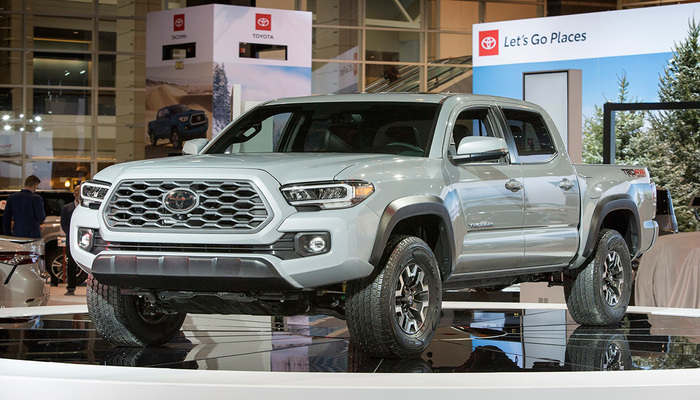
    Other big additions are outside the cab, such as the new LED headlamps, a new grille design and some slightly altered taillights. In short, many of the exterior design changes are aimed at making the vehicle look that much more modern and newer. This includes three-dimensional looking sequential turn signals, a few updated body lines and a more modern-looking front grille.

    Quality of Life

    The addition of a power driver seat in all but the SR trim is a welcome one. Additionally, the comfortable design of the seats makes the ride quality that much nicer, even when taking the truck off-roading. Terrain-select features are far from the norm in the truck world, so it’s great to see the feature on display here. The TRD and TRD Off-Road trims offer a terrain-select feature that includes options for rock and dirt, loose rock, mud and sand and more.

    Also on display in the TRD and TRD Off-Road is an active multi-terrain monitor that helps you keep an eye on what’s happening beneath the wheels. This is great, since it’s often hard to tell where your wheels are in the massive Tacoma, what with its giant hood in the way and the high driving position you’re in. In short, if you’re looking to take a truck off-roading, the 2020 Toyota Tacoma is going to be a solid choice in the TRD and TRD Off-Road trims.

    Under the Hood

    The base SR trim sports a 2.7-liter four-cylinder engine with only 159 horsepower and 180 pound-feet of torque, which isn’t exactly great for heading off-road. If off-roading is your thing, both TRD trims offer a great engine for doing just that. The engine on display under the hood of these trim levels is a 3.5-liter V6 engine sporting 278 horses and 265 pound-feet of torque.

    With the right equipment, the Tacoma can haul 1,600 pounds in the bed, or tow up to 6,400 pounds. While that’s not the best-in-class when it comes to hauling or towing, it’s impressive when you look at the frame the Tacoma sits on and the age of the base build. Whether or not this is a dealbreaker, of course, depends on how much you plan to tow.

    Safety Features

    The tech running in the 2020 Tacoma is impressive, to say the least. Driver safety features like automatic emergency breaking, pedestrian detection, lane-keeping assist and adaptive cruise control will all be shipping standard on the Tacoma line. Rear cross-traffic alerts and blind-spot alerts will also be shipping standard on TRD Pro and Limited trims, as well as being available on the other two trims as options.

    In short, this is the same Tacoma you know, now with even more great technology running under the steering wheel. It’s hard to go wrong with the new Tacoma if you’re interested in off-roading!

  • Toyota 4Runner Review: Most Rugged Mid-Size SUV?

    Toyota 4Runner Review: Most Rugged Mid-Size SUV?

    Toyota is a company known for making family-friendly vehicles that are reliable, if a little plain. One of their most well-known SUVs, the 4Runner, is a favorite among those looking for a rugged-but-practical vehicle. It’s great for going around town, going to soccer games and going on trips. Today, we’re taking a closer look at the design and features of the 4Runner to help you decide if it’s the right vehicle for you and your family.

    Toyota 4Runner

    Design

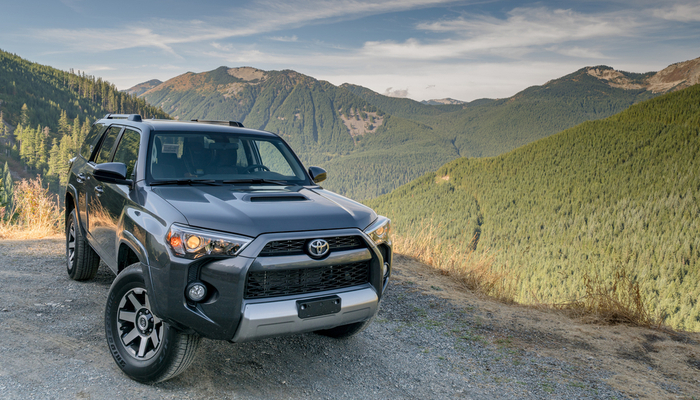
    The 4Runner has a very angular, boxy design that looks right at home among the rugged designs of companies like Jeep or GM. It’s a far cry from the softer, smoother appearance of Toyota’s Corolla or Prius models, and it stands apart thanks to its large front grille, high wheel arches and rectangular headlamps. The design is a bit divisive: some people love the rugged look, while others prefer the softer appearance of competitors’ SUVs.

    It’s worth noting that the rugged look of the 4Runner is more than just an appearance. It’s actually a rather sturdy vehicle, with body-on-a-frame design that allows it to go off-roading with no issue. If you spring for AWD, this SUV is a great choice for straying far from the beaten path. Thanks to the ample interior room, you’ll also have tons of space to haul your camping or fishing supplies, too!

    Interior

    Speaking of the interior, the 4Runner is a bit of an odd vehicle when you’re in the cabin. It’s a little lacking on the tech side, offering a slightly outdated-feeling infotainment system with a small touch screen and a low screen resolution. The infotainment system’s interface is a bit sluggish, and it can take some time to connect to Bluetooth devices like smartphones.

    However, the ride is comfortable, and the seats are cozy. The suspension allows for a smooth ride even over rough terrain, which is great for a vehicle you’ll likely be taking off-roading. This makes for a great experience riding around town, too, as the vehicle handles even poor-quality roads well while you’re commuting. This is all bolstered by the great cargo space. You can even lay the back seats down to increase the amount of storage space, making the 4Runner a good choice for people who love going camping.

    Engine

    The engine, like much of the 4Runner, is old-school and tried-and-true. It’s sporting a 4.o-liter V6 with a 5-speed transmission, the same engine that was first seen back in the 4Runner in 2004. However, Toyota seems to be sticking to a strategy of “don’t fix what isn’t broken”, as this vehicle’s engine works great for what it wants to do. The acceleration and handling are nothing to write home about, but they feel nice on a vehicle of this size.

    The power response from the engine is very smooth, and the ride stays nice and relaxing even when you’re getting up to highway speeds. This solid engine offers a great amount of power for what you need it to do, though it won’t be winning any drag races. That said, the engine is a bit of a gas-guzzler, drinking down a gallon of gas to go only 17 miles in the city, or 21 mpg on the highway.

    Bottom Line

    The 4Runner is an old-school vehicle. It sports designs that date back over a decade, and it shows in the fuel economy and lack of tech in the cabin. However, for the starting price of $34,810, it offers a very rugged driving experience to those who want a straightforward and pure drive. If you’re the kind of person who doesn’t want bells and whistles, just a solid vehicle with solid construction, you can’t go wrong with the Toyota 4Runner.


  • Samsung Still Makes Tablets? Galaxy Tab S6 Review

    Samsung Still Makes Tablets? Galaxy Tab S6 Review

    Believe it or not, Samsung still makes tablets. The newest Galaxy tablet, the Tab S6, offers a number of exciting new features to differentiate itself from the pack. While general interest in tablets may be down, Samsung seems to want to change that.

    While tablets were all the rage in 2013, the interest in them has cooled notably in the past few years. More and more phones are getting huge screens, while laptops are getting smaller, lighter and more affordable. Tablets are just being squeezed from too many directions. However, the Galaxy Tab S6 is here to prove that there’s still innovation to be found in the world of tablets.

    Under the Hood

    As you’d expect from any premium tablet, this thing is a beast in terms of processing power and overall strength. A Qualcomm Snapdragon 855 powers the device, allowing it some serious chops when it comes to rendering graphics, multitasking and playing games. In general, if you’re looking for the strongest Android tablet on the market, the Tab S6 has you covered.

    The screen is a huge, gorgeous AMOLED, coming in at 10.5 inches and sporting bright, vibrant colors. Much like the Galaxy S10, the screen is so crisp and clear that it gives you plenty of real estate to appreciate just how good the excellent camera on the device is. Quad speakers on the Tab S6 offer a ton of sound quality, creating a sonic landscape that is encompassing and deep without even needing headphones.

    New Features

    The S Pen that works with the tablet is great, as usual. It’s tremendously useful for productivity tasks, taking notes and thumbing through presentation slides. It’s also useful as a long-range camera shutter, allowing you to take pictures from your tablet even if you’re across the room from it. The strong magnets in the back of the Tab S6 allow you to slap the S Pen on there to get a charge. About ten minutes of charge should get you through a day of use, according to Samsung.

    The Book Cover Keyboard accessory makes the Tab S6 feel almost like an Android-powered laptop. It’s stellar for productivity, allowing you to use your tablet like a powerful, small computer for tasks like composing emails or writing essays. Combined with the excelled DeX desktop interface that comes with this version of Android, and you’ve got a very powerful, versatile device.

    DeX has mouse support, and, as such, the new Book Cover Keyboard has a trackpad. This allows you to use the Tab S6 essentially just like a laptop. Unlike most two-in-ones, which are laptops pretending to be tablets, the Tab S6 is actually a tablet doing a good laptop impersonation. While it won’t be replacing your MacBook for editing videos, it’s a great device for people who need to tackle everyday tasks.

    Other Goodies

    Thanks to the super-powerful processor running under the hood, the Tab S6 seems positioned to be a strong mobile gaming platform. Thanks to a partnership with Discord, Android promises you’ll be able to use the Game Launcher overlay to chat with your friends even while you’re gaming. The high resolution display and powerful processor have the Tab S6 well-suited to even the most demanding of Android games on the App Store. Simply put, this thing could crush some Fortnite.

    The on-screen fingerprint scanner and USB-C compatibility are just icing on the cake. The tablet comes in a variety of colors, including gray and blue, and will retail starting at $650. It comes with the S Pen, but the Book Cover Keyboard is an extra $180. Later this year, Samsung promises to launch a version of the Tab S6 with LTE built-in.


  • Anker Soundcore Liberty Air: Discount Price AirPod Killers

    Anker Soundcore Liberty Air: Discount Price AirPod Killers

    If you love the idea of wireless earbuds for your runs and walks, you’re likely intrigued by Apple’s AirPods. They’re stylish, they have great sound quality and they’re truly wireless. There’s a lot to love about them, except for that tremendous price tag. Coming in at around $160, the AirPods are seriously expensive for being small earbuds that don’t do a great job of blocking out other sounds.

    That’s where high-quality alternatives come into play. Anker’s Soundcore Liberty Air come in at the low price of $80, making them literally half the price of Apple’s offering. However, are you getting half the value when you go with Anker, or do the Soundcore Liberty Air earbuds live up to their “Airpod Killer” nickname?

    Sound Quality

    Of course, one of the first considerations when you’re looking at a pair of earphones is the sound quality. Thankfully, the Soundcore Liberty Air earbuds aren’t lacking on that front. The drivers, though small, pack a ton of punch. The bass levels are rich and smooth, not booming by any stretch but powerful in their own way. Mid-tones sound even and clean, and the higher register is audible even on loud, highly-compressed songs.

    One of the biggest strengths of the sound quality of the Soundcore earbuds is that they sport a rubber ear tips, creating a seal with the inside of your ear. This not only helps them stay put when you’re running or jogging, but it also helps them to block out outside sounds and makes the listening experience more encompassing. This is a marked improvement over the AirPods, which don’t do a great job keeping sound out.

    Design

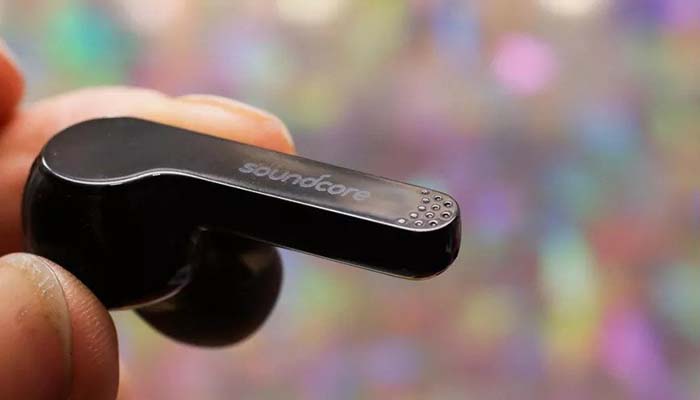
    If you’re not a huge fan of the “hair dryer” design of the AirPods, you’re likely going to like the look of the Soundcore Liberty Air earphones. They sport a shorter, flat tail, as opposed to the long, cylindrical tail of the AirPods. The back of both earbud is actually totally flat, making these discreet and stylish earbuds. As we mentioned earlier, they sport rubber ear tips that allow them to make a seal with your ear. Not everyone loves this earbud design, but if you do, these are great.

    They fit snugly in their charging case, which offers an excellent storage solution while also providing up to an extra three charges. Since each charge lasts around five hours, this means you’ll likely get a solid twenty hours if the earbuds and the charging case are both totally topped off before you leave the house. That’s a lot of juice for these little earbuds, making them a great companion for a commute or a long plane ride.

    Minor Quibbles

    On the negative side, if you don’t like the rubber ear tips, then you really don’t like them. They’re integral to the sound quality of these earbuds, as getting a good seal is how they deliver their sound. If you can’t get a good seal due to the shape of your ears, then you’re going to find these to be absolutely worthless earphones.

    Another small quibble is the charging case: it uses Micro USB instead of USB-C, making it a bit outdated in that regard. It also means the case charges a bit more slowly than it would if it used a more modern power cable.

    Bottom Line

    That all being said, the Anker Soundcore Liberty Air earphones are a great deal at $80. If you’re in the market for good true-wireless earbuds, then these are a great pickup. The only real concerns are the ear tip design and the somewhat-dated charging case. All-in-all, these earbuds are close to deserving their nickname of “AirPod Killers”.


  • 2020 Cadillac XT6: Better than the Escalade?

    2020 Cadillac XT6: Better than the Escalade?

    How long ago did Cadillac first roll out the Escalade? If you remember all the way back to 1998, that was the first year Cadillac put that monster of an SUV on the market, for the 1999 model year. It was the first time Cadillac had really dipped their toes into the SUV market, and the results were unpredictably successful for the luxury carmaker. However, the 2020 model year is packed with a number of luxury SUVs all competing for the same buyers. It’s time for something new.

    Enter the 2020 Cadillac XT6. The newest vehicle from Cadillac is expected to be a fierce competitor in the full-sized luxury SUV world. The enormous unibody design and the transverse-mounted engine are actually shared with the likes of the Buick Enclave. Today we’re breaking down the newest luxury SUV from Cadillac. Is the XT6 better than the Escalade?

    Design

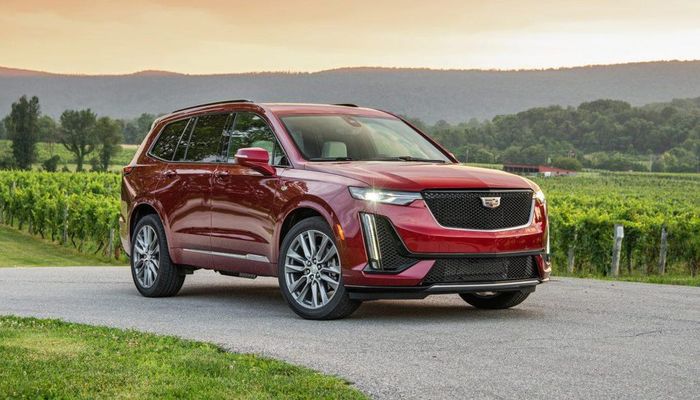
    This sure is a full-sized luxury SUV. 21-inch tires, a huge footprint, a nearly 16-foot long body and a very high seating position make this a natural fit in the category. The narrow, nearly “squinting” headlights also add to the look of a giant vehicle trying to squeeze into a non-imposing profile despite its size. Soft curves along the back and sides of the SUV also help it to look “squeezed” down to a smaller appearance than its actual dimensions.

    If you’re a fan of Cadillacs, the trademark look is here in force. The large, black front grille with the iconic Cadillac emblem stand out on the front of the vehicle, as does the smoothly-sweeping design along the side of the vehicle. This is, visually, a fit successor to the Escalade.

    Under the Hood

    This isn’t a sports car by any measure, but it drives well for a huge SUV. Despite being three rows and sporting a massive footprint and huge wheels, the XT6 handles rather well around town and on the highway. It’s not going to be winning any races, of course but it’s nice to drive as a daily driver.

    The AWD present in some options is powered by the GKN twin-clutch system, which is also seen on the Audi TT-RS and Ford Focus RS. Essentially, this gives the vehicle a great deal of control over its yaw, allowing the torque to be actively moved from side to side in order to keep the body roll to a minimum. It makes for a great-feeling ride, along with the quiet cabin and smooth transmission.

    Infotainment

    This is, in every way, a luxury vehicle. The new rotary jog wheel allows for control of the infotainment system that doesn’t require you use a touch screen. It’s much safer to not take your eyes off the road when you’re driving, so an option for controlling a touch screen without touching it is stellar. Of course, if you’re at a stop or riding passenger, you can still use the touch screen as per normal.

    Pricing and Bottom Line

    The XT6 is available at two trim levels. The first is the Premium Luxury trim, which comes in at $52,695, and comes standard with front-wheel drive, forward-collision warning, blind spot monitoring, lane-keep assist and more. The Sport trim, on the other hand, which comes in at $57,095, which comes with AWD, a more aggressive suspension and tighter steering. Both have numerous options available across the vehicle’s numerous add-ons.

    This is a solid SUV, a good replacement for the Escalade and likely another big success for Cadillac. If you’re in the market for a huge SUV with a great ride, comfortable cabin and stylish design, then the 2020 XT6 is the car for you.


  • Bose Noise Cancelling 700: Still the Gold Standard?

    Bose Noise Cancelling 700: Still the Gold Standard?

    When you hear the name Bose followed by the words “Noise Cancelling” you know you’ve got a solid piece of audio hardware in front of you. Whether you’re taking a long trip on an airplane, commuting via train or just trying to zone out in the break room, noise cancelling headphones can be huge lifesavers.

    The new Bose Noise Cancelling 700 headphones are upon us, and today we’re answering the question everyone has: are they still the gold standard in audio hardware? Let’s take a closer look.

    The Bose Standard

    The Bose 700 is a follow-up to the now-ancient Bose QuietComfort line, which first hit the market in the year 2000. That’s nearly twenty years ago now, and while the model went through a number of cosmetic changes, the innards remained largely the same for the better part of two decades. So, what’s so new and different that Bose had to introduce a brand-new line of headphones?

    Well, a lot. Firstly, the drivers that pump the sound out and the microphones that detect (and cancel) ambient sound are all brand-new for this headset. The construction is all new, too, incorporating a single stainless steel band that makes the whole set sturdier and more impressive in the hand. The rubberized padding on the inside of the ear cups is new, too. It’s comfortable and sweat-resistant, and a far cry from the old cloth and foam padded cups of the QuietComfort 35 II.

    What Else is New?

    There’s a lot of new things going on under the hood with the Bose 700, as well. There’s been a push on the part of Bose to make these headphones well-known as being great for taking phone calls, too. And, to their credit, they work rather well as headsets for taking phone calls, in case you get called in the middle of your commute or work day.

    The headset’s noise cancelling technology does a great job of preventing the person on the other end of the call from hearing the ambient noise around you, too, which is a huge help. The beam-forming technology in the mics can zero in on your voice and transmit just that to the other person. You can also toggle on voice monitoring so you can hear your own voice through the headphones so you’re not shouting in a quiet room.

    Sound Quality

    We haven’t even touched on the most important part of any pair of headphones: the sound quality. As expected, it’s excellent. The drivers offer up crisp and clear sound on the mid-levels as well as on the bass. The bass isn’t as punchy or powerful as comparable Sony headphones, though it’s much tighter and hits with a lot more precision.

    This isn’t to say that the bass isn’t deep on these headphones: it is. However, when compared to some other high-end headphones, it can be ab it more controlled. This isn’t a good thing or a bad thing, it’s just the nature of these drivers. Unless you’re listening to a lot of music on a lot of different headphones, you likely won’t even notice the differences.

    Bottom Line

    The sound-canceling on display here is top-notch. The only competition hitting a similar benchmark is Sony, as some of their top-notch offerings are on similar territory. This is all to say: if you want the best, it’s this or Sony. As for the nitty-gritty differences, it’s all down to a matter of preference.

    If you’re looking for the top-of-the-line noise cancelling headphones and can stomach the $400 price tag, the Bose Noise Cancelling 700 are a great pair of headphones. They remain the gold standard, and Bose remains nearly unmatched at the top of the heap.


  • 2019 Honda CR-V: How Does it Stack Up?

    2019 Honda CR-V: How Does it Stack Up?

    The 2019 model year CR-V is upon us, and Honda’s best-selling car looks pretty solid. Is it a worthy competitor to the Toyota RAV 4, though, or does Honda’s biggest rival take the small crossover top spot this year? Today we’re taking a closer look at the 2019 CR-V to answer just that.

    2019 Honda CR-V

    What’s New?

    There’s actually very little that’s new in the 2019 CR-V when compared to the 2018 model. This is the same fifth-generation CR-V we’ve been seeing for the last few model years. That being said, it sports a great suite of technology still and the styling is still modern and sleek. As for brand-new features, the only notable option is the new white paint scheme.

    As for things you won’t find this year, a trim level has been deleted from the roster for 2019. The more simplified range is a good thing for this more budget-level small SUV: as one of Honda’s mainstays and a great practical car, it’s not exactly competing with BMW or Tesla. We appreciate the more concise model range with a simpler statement of purpose: this is a practical car for working families.

    Design

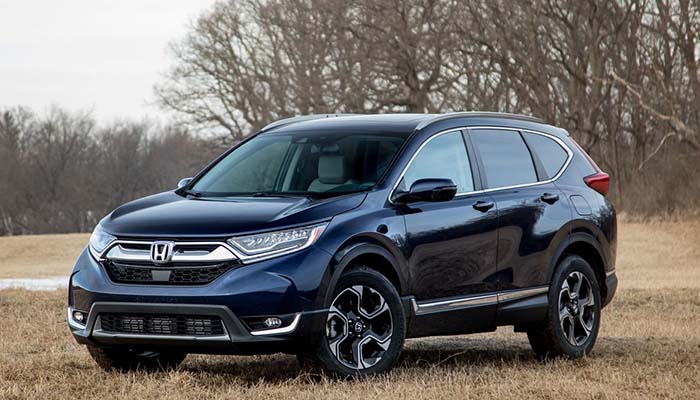
    Much like last year, the fifth-generation CR-V looks great. The styling is modern and slick, and we love the black-painted touches on the rims. Other neat flourishes include the rear taillight molding that gives a 3D effect, the chrome, black and grey plastic finishes all add together for a modern and clean look. Style lines across surfaces like the door panels, framing the grille and across the hood give the car a lot of visual coherency.

    The interior is similarly modern and feels clean and stylish without looking gaudy. We love the soft-touch materials over most major surfaces, as well as the tasteful wood grain finish in some of the panels. From the driving position, the layout is smooth and draws the eye to the infotainment system, which we’ll get to in a moment. From the passengers’ positions, the car’s surroundings are comfortable and calming.

    Interior Tech

    About that infotainment system: the screen is large and bold, and the touch controls are responsive. Honda’s proprietary display-audio system is at work here, and it’s great. The image resolution looks solid, and, while not being the most impressive on the market, works well for what this car is trying to do. Oddly, there’s no wi-fi hotspot option for this vehicle. This is an odd touch for an otherwise modern car.

    That being said, modern touches are also here: the Display Audio system has functionality for both Apple CarPlay and Android Auto, which both allow you to sync your smartphone with your car’s infotainment system. The Display Audio system is also easy to learn and navigate if you’ve not encountered it before. All in all, this is a solid suit of tech for an SUV of this class.

    Practicality

    The interior storage space and drive train are as you’d expect from a CR-V. It can carry tons of stuff, making it a great grocery-getter, and it drives fine. It’s neither fast nor slow, sporting its 190 horsepower and 179 pound-feet of torque in all trim levels but the base LX. It’ll get you on to the highway and around town, but it won’t do so with any panache.

    The ride is smooth and comfortable, much like the interior of the vehicle. Even on a rough road with many bumps and ruts, you’ll likely feel fine as the vehicle just trucks along. From its starting price of $24,450, it’s a great deal for anyone looking for a good daily driver. We’re happy to report that the 2019 CR-V is still on top when it comes to small SUVs.


  • Best Smart Speakers in 2019

    Best Smart Speakers in 2019

    While smart speakers were once seen as an unusual curio that your rich friends might have in their kitchen, they’ve become much more commonplace recently. The helpful and friendly voice that issues forth from the speaker is only part of the draw of these devices: they offer a wide variety of smart home functionality that you have to see to believe.

    If you’re thinking about getting a smart speaker but don’t know which one to go with, you’re not alone. There are a few great options out there, but it can be difficult to narrow the options down. Let’s take a look at some of the best smart speakers on the market to help you make a good decision.

    Apple HomePod

    Apple’s HomePod is something a black sheep when it comes to smart speakers. Powered by the familiar, if a bit outdated, Siri assistant that also runs in Apple’s phones and watches, HomePod is great for Apple lovers. It’s part of the Apple ecosystem, allowing for great integration with your iPhone, your Apple Watch and your Apple Music account. If you’re already rocking AirPods and an iPhone, you’re probably going to love the HomePod, too.

    However, if you’re not already an Apple faithful, you’ll probably find the HomePod’s steep asking price of $300 to be a bit much. Siri’s a bit more limited in her responses and case functions than Google Assistant and Alexa, as well. This all being said, the HomePod offers incredible sound that is tailored to the size and shape of the room it’s in. If you love Apple, or want a stellar sound quality, the HomePod is for you.

    Google Home Mini

    Google’s well on their way to world domination, and the Home Mini is a good indicator of why. The useful and great-sounding little speaker retails for just $50, making it a good entry-level option for those curious about the smart speaker “thing.” Google Assistant is really good at understanding commands, and can interpret plain language better than either Siri or Alexa. Not to mention, the assistant sounds normal and has human-like inflection, which can be comforting compared to the slightly robotic Siri.

    Google’s Assistant works very well when you need it to read off recipes or walk you through tasks you’re having it look up for you. If you forget the name of a smart home feature you have, it can normally figure out what you’re talking about. It’s also got a wider variety of smart home devices that it works with than the HomePod, coming close to the variety offered by Alexa’s Echo family of devices.

    Amazon Echo

    Amazon Echo devices are some of the most popular smart speakers on the market, for a number of reasons. Firstly, Amazon’s devices are often on sale on their online web store, and the devices are advertised heavily on TV. Alexa has a natural-sounding and calming voice, and can answer a number of questions and perform a lot of tasks for you with just your voice commands. If you’re just looking to try out a smart speaker and see what it’s all about, you want an Amazon Echo Dot, which can be found for $50 online.

    While Alexa might not be the clear winner in 2019 like she was in 2016, Amazon’s device is still the most useful overall for the price. There are so many smart home devices that are compatible with Alexa that you can safely buy just about any smart bulb or smart lock and know it’ll work with your device. The sound quality on the speaker is great for the price, and you can even hook the device up to your own speaker if you want to get better quality sound out of it. All in all, this is a great option for newcomers to the field.


  • Xiaomi Mi A3 Review: A Worthwhile Budget Android Phone?

    Xiaomi Mi A3 Review: A Worthwhile Budget Android Phone?

    Fans of Android phones have a big leg up on iPhone users when it comes to budget options. If you like high-end smartphones, both Android and iOS have great flagships you can pick up. However, if you’re in the market for a smartphone under $300 and you like iOS, you’re going to be rocking a four-year-old phone at best.

    Android, on the other hand, has a wealth of mid-range and budget phones from various manufacturers that still function as great daily-use cell phones. One such phone is the upcoming Xiaomi Mi A3, the newest in Xiaomi’s “A” line of mid-range Android phones. Is the A3 a worthwhile phone at its budget price, or does it leave too much to be desired? Let’s take a look.

    The Specs

    An important aspect of any smartphone is the technical specifications. The Mi A3 isn’t exactly loaded with top-of-the-line tech, but it’s also only retailing for around $280. The phone is powered by the Snapdragon 665 system on a chip, offers up 4 GB of RAM, and is running an Adreno 610 GPU. The phone has a good number of ports: a 3.5mm headphone jack makes a return, as does the fan-favorite IR blaster (allowing the phone to be used as a universal TV remote).

    Unfortunately, the display of the Mi A3 is only 720p, which leaves a lot to be desired. The screen is OLED, which means it offers great blacks and deep contrast, but the lower-resolution display is very unusual. For the price, it would have been nice to see the A3 sporting a 1080p screen. As it stands, the phone likely won’t age well.

    User Interface

    The A3 also isn’t running Xiaomi’s in-house Android skin, but is running on the stock Android One program. This means that, like the previous “A” models, the A3 will only receive two years of software updates from Google. The Android One program is Google’s way of letting budget phones exist at a lower price by running a bare-bones, minimalist version of Android.

    As such, all the inherent strengths of the open Android OS are here, as are all of its rough edges and warts. If you already love Android, there’s nothing here that will make you hate it. Likewise, if you’re ot an Android fan, the bare-bones Android One won’t be convincing you.

    US Customers

    It’s worth noting that US Customers will need to be wary of the A3’s LTE compatibility. The LTE bands that the phone is compatible with are 1, 2, 3, 4, 5, 7, 8, 20, 28, 38, and 40. This means that the phone isn’t completely compatible with any US carriers. However, T-Mobile is the closest to full support for these bands, so consider the A3 if you use T-Mobile, or don’t mind not always having LTE coverage.

    Xiaomi isn’t exactly a well-known brand in the US: in fact, most Chinese smartphone manufacturers aren’t. Only diehard Android fans tend to know names like Huawei and Xiaomi, though that’s not to say you can’t get the A3 in the US. Sites like Amazon will sell the phone unlocked, so all you need to do is take it to a carrier and have it activated.

    Bottom Line

    For around $280, the A3 is a good deal. The design is sleek, the interface is solid and the included headphone jack and IR blaster are nice to have. If you’re a stickler for nice displays, however, the 720p image is likely to turn you off from this phone. Likewise, the bare-bones software and two-year limit to software support might scare off more tech-savvy users, and the lack of full US LTE coverage could cause some customers to pass on this budget Android phone.


  • 2019 BMW X3: Luxury SUV Review

    2019 BMW X3: Luxury SUV Review

    BMW’s luxury SUVs have a sterling reputation for a number of reasons. The 2019 X3 has some great expectations behind it: after all, it bears the name of one of the most beloved luxury SUV lines in the world.

    That said, the 2017 and 2018 model years have been a little lackluster for BMW. After a few disappointing entries in both sedan and SUV categories, has BMW returned to form with the 2019 X3, or is this another limp entry in the German automaker’s lineup? Let’s take a closer look.

    New in 2019

    As you may know, the X3 got a full redesign in 2018. While that entry was solid, it wasn’t exactly of expected BMW quality. That said, the updates this year are iterative, not revolutionary. What has changed is enough to make this a more notable car, though.

    Firstly, safety features are more robust now. Options for forward-collision warning, parking sensors and automated emergency brakes have been made standard for 2019. If you opt for the Premium package, you’ll get a heated steering wheel and front seats, real-time traffic updates for the navigation, Apple Car Play and 19-inch wheels. For the more sport-minded driving enthusiasts, the M40i X3 offers a sport steering wheel, as well as a turbocharged six-cylinder engine.

    Engine

    One of the weak points of the last few model years for BMW has been the somewhat boring drive. Thankfully, that trademark verve is back on display in the 2019 X3. This goes double for the M40i, but the other engine options are also stellar and just plain fun to drive. Despite being an SUV, the vehicle is agile and feels light as you maneuver it around the road.

    Even the base powertrain sports 248 horses, though it takes them 6.2 seconds to get up to 60 mph. That said, fans of power can always opt for the M40i, getting a respectable 4.4 second 0-to-60. Optional adaptive suspension allow for a great, sportier ride for some occasions though it can shift into a smoother ride for around-town driving. No matter your preference, the X3 offers a great driving experience.

    Interior

    The base interior of the 2019 X3 is luxurious even with base equipment, before adding any options. Plush seats that are easy to adjust make for a great ride, while premium-feeling interior surfaces lend the interior an upscale and stylish feel. Faux wood grain paneling looks almost just like the real thing, as do the faux leather door linings and dash coverings.

    Brushed nickel finish in places, as well as the large, vibrant infotainment system help to sell the modern interior as one of superior luxury. All of this makes for a great interior, though the glaring omission of Android Auto is a bit surprising, given BMW’s typically technology-driven designs.

    Pricing

    As we mentioned earlier, there are some notable differences in trim levels and pricing packages. The base rear-wheel sDrive30i starts at $41,995, while the all-wheel xDrive30i comes in at $43,995. The sportier, more aggressive M40i, with its inline six cylinder, starts at $55,645, making it notably pricier than the other powertrain options. Premium package upgrades are also available, as are a few different trim levels. In short, expect to pay full luxury BMW prices for the X3.

    If we had to spec out our own BMW X3, we’d go with the M40i powertrain, the Premium package, and the Luxury Design trim. While this ends up being one of the more expensive builds of the X3, it results in a sporty, agile and luxurious vehicle that is fun to drive and great for upscale evenings out with friends. In short, if you’re going to buy a luxury car, why not go all-out?