Tag: tech throwback

  • Tech Throwback: The Sega Genesis CD

    Tech Throwback: The Sega Genesis CD

    I like to take a look at where I’ve been to evaluate where Im going. Technology is cyclical after all… wait no its not. That said I still like all the feels that come rushing back like a flood of nostalgia every time I get my hand on the tech I grew up with. Im going to go back periodically and take a looking at the stuff that used to blow our hair back and get our minds rolling. Some of these device blew up and changed the world, some where ahead of their time and some just fell flat and became colossal failures. Today we are going to talk about the Sega Genesis CD

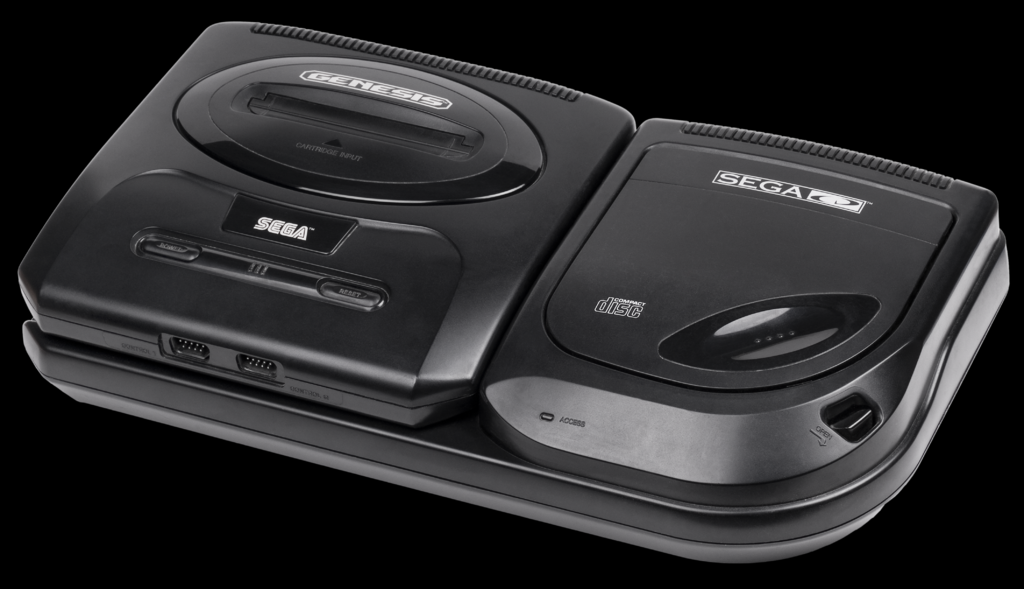
    When this CD-ROM accessory was released in 1991 for the Sega Genesis video game console, video gamers everywhere rejoiced. Let’s take a look at one of tech’s most beloved creations of the ’90s. While this was highly anticipated it was rarely adapted. The way this worked was you would purchase the Sega Genesis CD and plug it in to your existing 16 bit console allowing you to play PC like CD ROM games. The main benefit of CD technology was greater storage, which allowed for games to be nearly 320 times larger than Genesis cartridges. This benefit manifested as full motion video.

    The Games

    The Sega CD supports a library of over 200 games created both by Sega and an array of third-party publishers. Included in this library are six games which, while receiving individual Sega CD releases, also received separate versions that utilized both the Sega CD and 32X add-ons. Among the games released for the add-on were a number of FMV games, including Sewer Shark and Fahrenheit. Well-regarded games include Sonic CD, Lunar: Eternal Blue and Lunar: The Silver Star, Popful Mail, and Snatcher. And we wont even talk about the controversial Night Trap.

    Lets Play the Sega Genesis CD

    So for the small price of almost $300 I was able to get an original in box Sega Genesis with The Sega Genesis CD and one game.. Ecco The Dolphin. Ecco the Dolphin is an action-adventure game originally developed by Ed Annunziata and Novotrade International for the Sega Genesis CD.

    Since this is the only game I have and the only game I really remember from my brief time with my neighbors Sega Genesis CD. This is the game we are playing today. Basically you are a Dolphin, swimming around doing Dolphin stuff. Attacking enemies is accomplished by making Ecco ram into them at high speeds. Swimming can be made progressively faster by tapping a certain button. The speed can be maintained by holding it down. You can also perform a purely aesthetic spin in the air when jumping out of the water. Its ok and my nephews are loving it

    The Final Thought

    While this flopped, it was groundbreaking. Shortly after it would pave the way for the PlayStation and Sega DreamCast and for that we are grateful.
  • Tech Throwback: America Online

    Tech Throwback: America Online

    I like to take a look at where I’ve been to evaluate where Im going. Technology is cyclical after all… wait no its not. That said I still like all the feels that come rushing back like a flood of nostalgia every time I get my hand on the tech I grew up with. Im going to go back periodically and take a looking at the stuff that used to blow our hair back and get our minds rolling. Some of these device blew up and changed the world, some where ahead of their time and some just fell flat and became colossal failures. Today we have not just a tech throwback, not a device or toy, but an internet revolution. The name even says it all… America Online, and that is just what happened. America went on line.


    And so it was America On Line or AOL as we came to designate this revolution first started out in 1983 as an online video game service for the Atari 2600. Shortly after that founder and CEO  Bill von Meister wanted to converge in to a music on demand service. The idea was squashed by Warner bros music department…

    Later in the decade, these innovative thoughts and dream has merged into an online portal for the commador 64 and apple II, called q-link. Then in August 1988, Quantum launched PC Link, a service for IBM-compatible PCs developed in a joint venture with the Tandy Corporation. After the company parted ways with Apple in October 1989, Quantum changed the service’s name to America Online. Case promoted and sold AOL as the online service for people unfamiliar with computers, in contrast to CompuServe, which was well established in the technical community.

    Its now 1991 and AOl Charged its users an hourly fee, mostly gamers where using the platform and it hosted 2 exclusive dungeons and dragons, title called Neverwinter Nights from Stormfront Studios; which was one of the first Multiplayer Online Role Playing Games to depict the adventure with graphics instead of text. Gaming was still the backbone of America Online.

    America Goes on Line With America Online

    In 1996 America Online changed its billing and pricing from an hourly rate to a 19.95 monthly fee. America responded. During this time, AOL connections would be flooded with users trying to get on, and many canceled their accounts due to constant busy signals.

    What We Remember

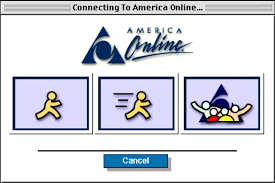
    BEEEEEEEE DEEEEE DEEEEE. We all remember the sound to connect, the little guy running across those little boxes to get on the line. They after a few eternal minuets, You’ve got mail… With only a handful of boxes to click on, we were blown away by all the endless information we now had at our finger tips.

    Then the Chat Rooms, oh we spent weeks of our lives during the late 90s in those rooms. The connections we discovered to random people validated our very existence. We had reached a pinnacle of society and were all now connected.

    And all those free trial disks and cds. We collected them, used them to create new account for temporary or incognito service, then

    The World at Our Finger Tips

    America Online brought us on the line, all of us, on the line. Now we are all here, what do we do with this unprecedented power? Globalization. AOL is the backbone of our world today, it set it up and paved the way for Amazon, Ebay, Napster and all of the internet companies that could turn minuet transnational profits to worldwide unimaginable wealth.


    The Final Thought

    It would take the world almost a decade to catch up to Americas latest boom. Instantly, due to our ingenuity, desires and “why cant we” bravado made another giant leap in society. Much like everything else in america, their was a meteoric rise, unprecedented success, and the world was forever changed overnight. The following year would see mergers and purchases, evolving in to a giant conglomerate. Today AOL is nothing more then a small branch in Telecom giant Verizon’s portfolio, but for a time it was a revolution.


  • Tech Throwback: Kodak Brownie Camera

    Tech Throwback: Kodak Brownie Camera

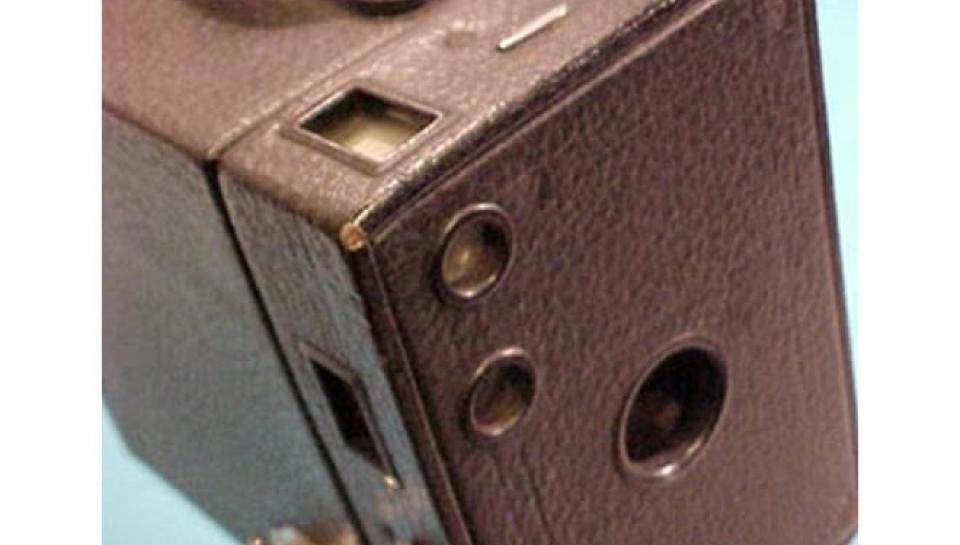
    I like to take a look at where I’ve been to evaluate where Im going. Technology is cyclical after all… wait no its not. That said I still like all the feels that come rushing back like a flood of nostalgia every time I get my hand on the tech I grew up with. Im going to go back periodically and take a looking at the stuff that used to blow our hair back and get our minds rolling. Some of these device blew up and changed the world, some where ahead of their time and some just fell flat and became colossal failures. Today I’ve got my hands on the old and original Kodak Brownie Camera.


    The Original

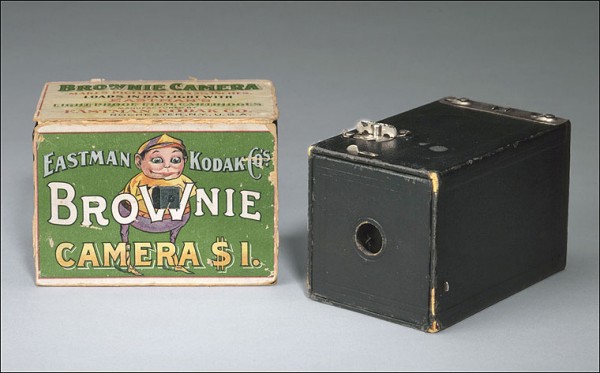
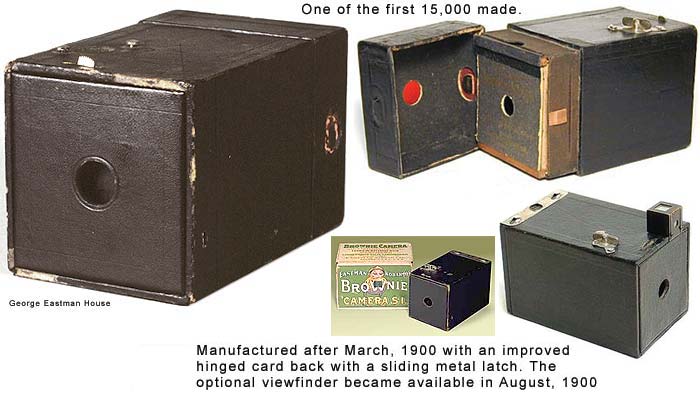
    IF you have ever taken a real photography class, you know the best way to teach someone how a camera works is to have them make there own Kodak Brownie Camera. Kodak Marketed toward there camera to the turn of the century children. They were issues and  carried by soldiers. At the hefty 1900’s price tag of $1 (about $29 today)  they were affordable to everyone. Its a small, brown leatherette and cardboard camera and introduced the term “snapshot” through its ease of use and low cost.  it was introduced in February 1900, the Brownie took cameras off tripods and put them into everyday use. For Kodak, the low-cost shooter was the hook that allowed the company to reel in money through film sales. And for the rest of the world, it helped captured countless moments and shape civilization’s relationship to images.

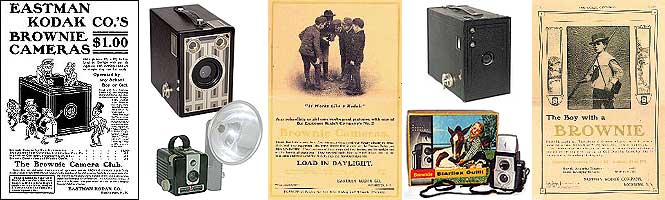
    The first model of the camera was invented by Frank A. Brownell. The name comes from the brownies in popular Palmer Cox cartoons. Consumers responded, and over 150,000 Brownie cameras were shipped in the first year of production. Over the years it was extremely popular and many versions of it existed.  There where many models over the years with feature and functionality improvements. My personal favorit was the Beau Brownie..

    Beau Brownie

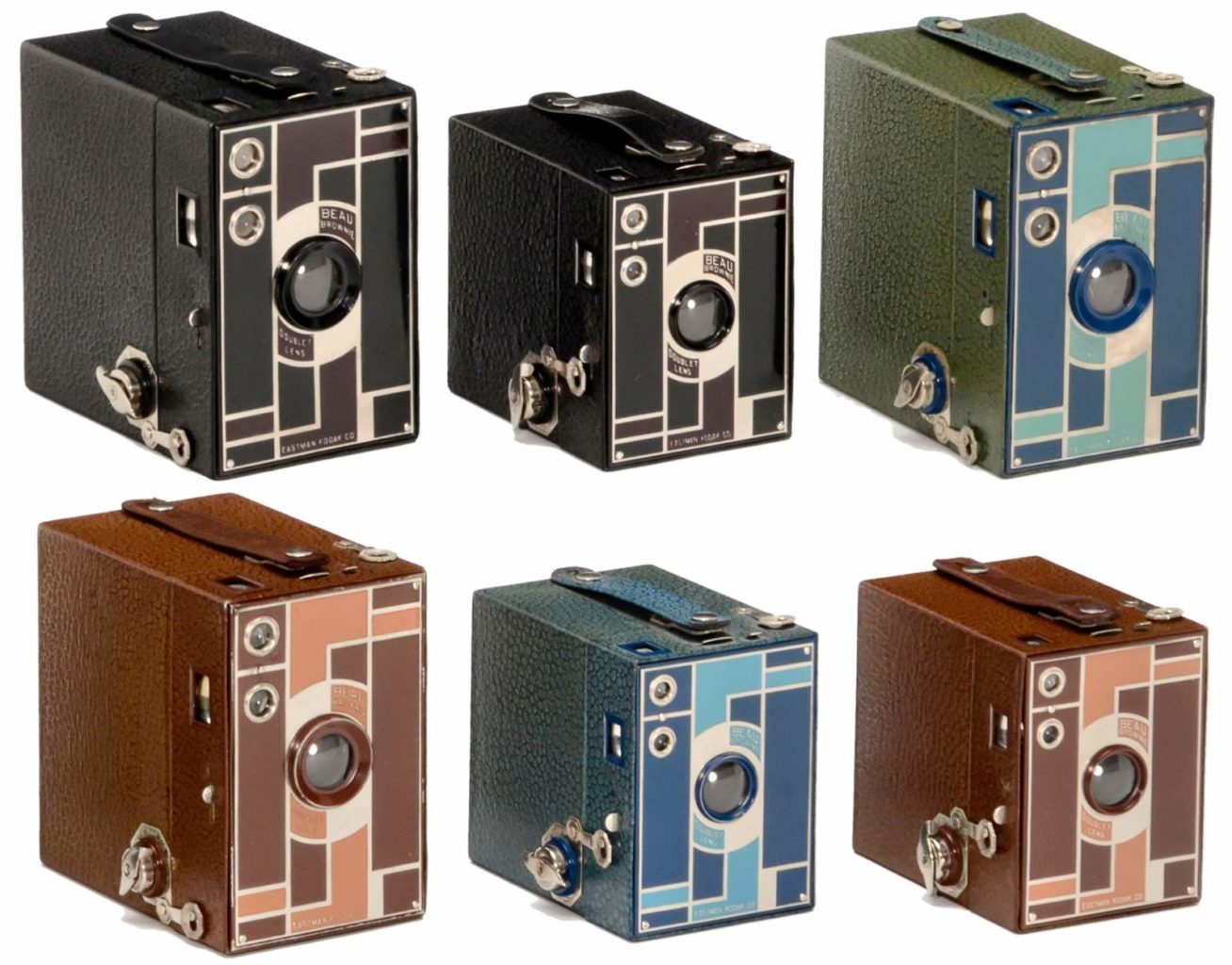
    The Beau Brownie  was  a new version of the Brownie sold  from 1930 to 1933. They  had very little technical variation from the immensely popular Brownie cameras. With the only one big technical difference being the introduction of a new doublet lens, allowing the same picture to be projected on a film plate over a shorter distance and this made the Beau Brownies nearly 2″ shorter than their conventional counterparts. With an updated Art Deco design with an  enameled two-tone front plate, it was a stunning example of period tech. It was produced in  in five color combinations: black and burgundy, brown and tan, two-tone blue, two-tone green, and two-tone rose.

    Basic Operation

    The Brownie operates under the following sequence of events:

    1. A shutter in the front of the camera is opened allowing light to pass through the lens. This light is reflected from the object being photographed.
    2. As the light passes through the lens it forms an image of the object being photographed. As it continues through the lens, this image is inverted (turned upside-down).
    3. The lens projects the inverted image onto light-sensitive film at the back of the box. This is known as exposure of the film. The longer the shutter is left open, the more light is allowed onto the film.

    Does it get any simpler?

    The Final Thought

    One look at theses you instantly know what is is and where it came from. There are a little over a hundred variation of this original, portable, and everyday camera, but one definitely has its place in your heart,assuming you are older then 45 of course. Its evolution over its 100 year span was predictable and outstanding all at the same time holding true to its core design.  All I can say about the Kodak Brownie Camera is It came, It saw, and It captured an entire century.

  • Tech Throwback: The T-Mobile Sidekick

    Tech Throwback: The T-Mobile Sidekick

    I like to take a look at where I’ve been to evaluate where Im going. Technology is cyclical after all… wait no its not. That said I still like all the feels that come rushing back like a flood of nostalgia every time I get my hand on the tech I grew up with. Im going to go back periodically and take a looking at the stuff that used to blow our hair back and get our minds rolling. Some of these device blew up and changed the world, some where ahead of their time and some just fell flat and became colossal failures. Today I’ve got my hands on the T-Mobile Sidekick


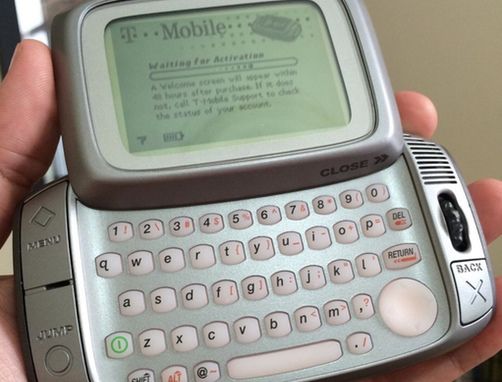
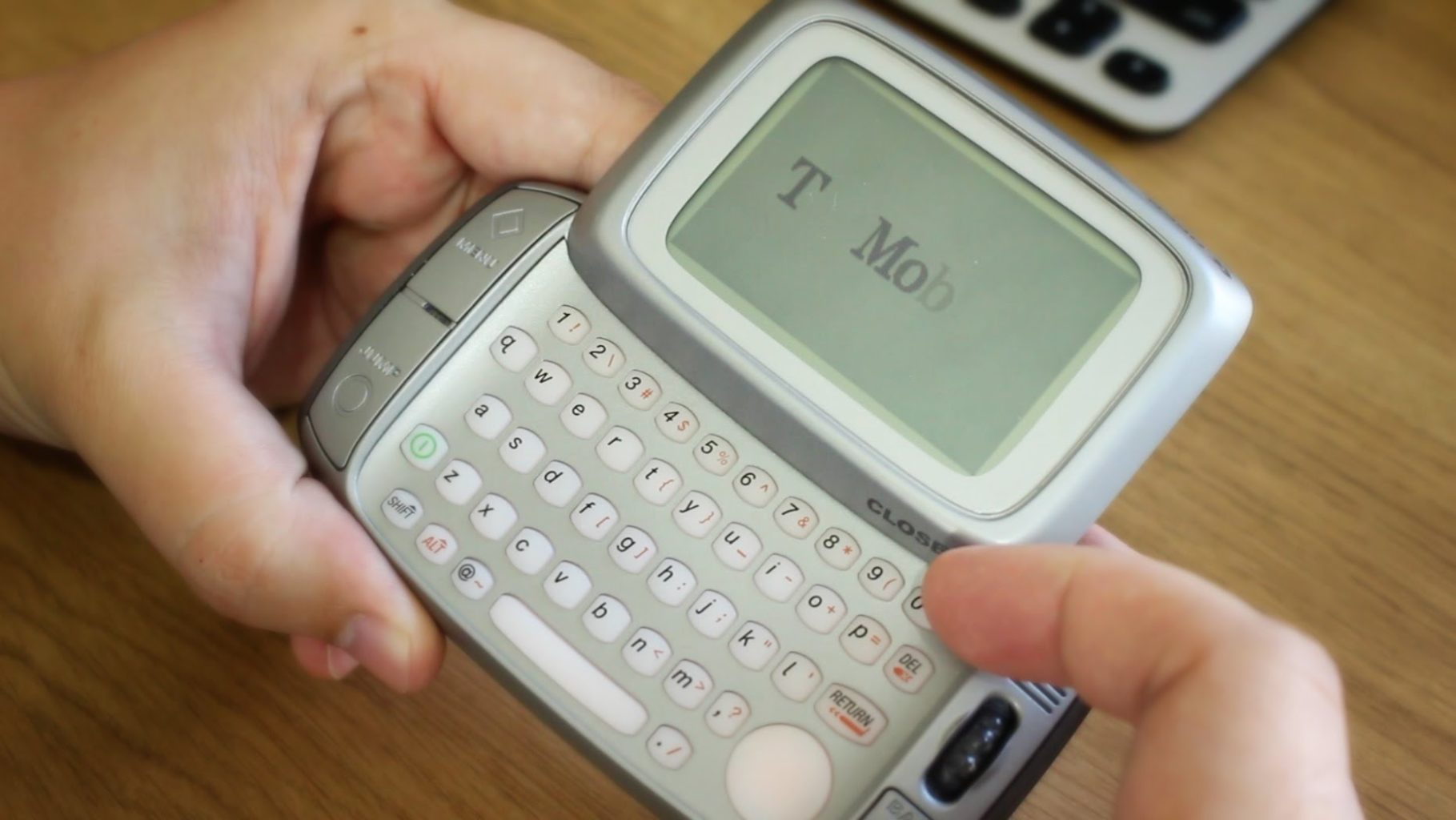
    The Danger Hiptop, also re-branded as the T-Mobile Sidekick, Mobiflip and Sharp Jump is a GPRS/EDGE/UMTS smartphone produced by Danger Incorporated  from 2002 to 2010. Released on October 1, 2002, the original Hiptop was unique compared to all other hardware versions. All the units, from the beginning, have featured “Menu”, “Back”, “Jump” and other keys accessible even when the unit was closed. The Hiptop also featured a speaker which is used for device sounds but not telephone. Along the top edge of the phone bezel is an infrared transceiver. The headset jack serves a dual purpose, as it is also used for the accessory camera. A later revision of the Hiptop upgraded its screen from a monochrome LCD to a color LCD viewable with or without the backlight on


    Powering Back Up the T-mobile Sidekick

    Like I like to do I purchased one of the original T-mobile Sidekick. First thing I notice is how thick it is. It is girthy to say the least, its like holding 3 iPhones. The flip screen is still snappy. This was a one of a kind phone, no one else even mocked it. The spinning rotating screen is still unique with its 180 degree flip to reveal the key board. The keyboard is nice and very well spaced out. For text messaging this phone was way ahead of its time and is still probably the best and most efficient SMS device.

    This phone is the original basic smartphone. It has still an advanced for the time but basic phone OS. The best way to describe it is to say its very PDAish but with a killer keyboard. The picture quality, let talk about it, its rubbish. black and white and grainy. Im actually terrified that some hipster will find one of these and turn it in to the next hipster camera trend. Posting terrible pictures is just the kind of thing that is up their ally.

    The Final Thought

    I never had the Sidekick, it was a T-mobile exclusive and I was a Cingular guy. This was the most experience I had with the sidekick. I can say it is interesting, fun, quirky, qwerty and perfect for its time. Its success was limited to the T-mobile network which was not great. Many other instances of the T-mobile Sidekick was released in subsequent years, some of them didn’t even kick out.  The last thing Ill say about this device is just like its most famous users, Hanna Montana and Paris Hilton, it belongs in 2003. Lets leave it right there.

  • Tech Throwback: Sony Walkman

    Tech Throwback: Sony Walkman

    I like to take a look at where I’ve been to evaluate where Im going. Technology is cyclical after all… wait no its not. That said I still like all the feels that come rushing back like a flood of nostalgia every time I get my hand on the tech I grew up with. Im going to go back periodically and take a looking at the stuff that used to blow our hair back and get our minds rolling. Some of these device blew up and changed the world, some where ahead of their time and some just fell flat and became colossal failures. Today we are going to talk about the Sony Walkman


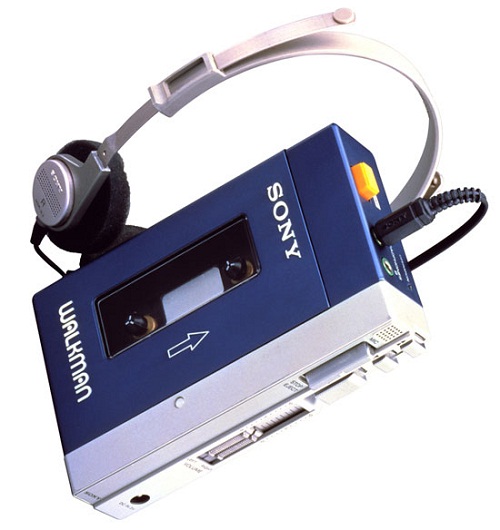
    Walkman cassette player, released in 1979, changed music listening habits by allowing people to listen to their music whilst on the move. This could turn everyday tasks like commuting and running into pleasurable experiences. It gave commuters a sense of privacy, and add a soundtrack to urban surrounding. At the time a lightweight portable stereo system where that of future fantasy. Sony’s current portable option was the 5 lb TC-D5 and It was far to heavy and expensive to be revolutionary. We all just had to be content with listening to records in our basements. Then June 7th, 1980 happened, hello Walkman


    little fun fact about the Walkman name, the Walkman name was thought to be too Japanese- English so it was called the soundabout in the US at first. It was nearly called the Disco-Jogger. Thank Thanos that didn’t happen, I can tell you the Disco- Jogger would not be getting its own Tech Throwback Spotlight…

    Sony Walkman, Just Press Play

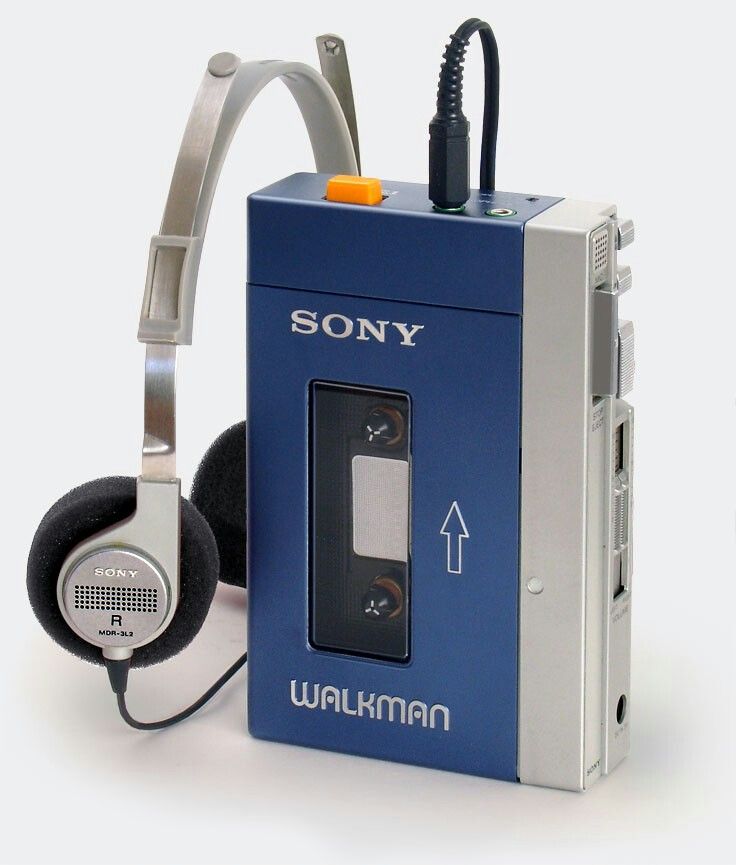
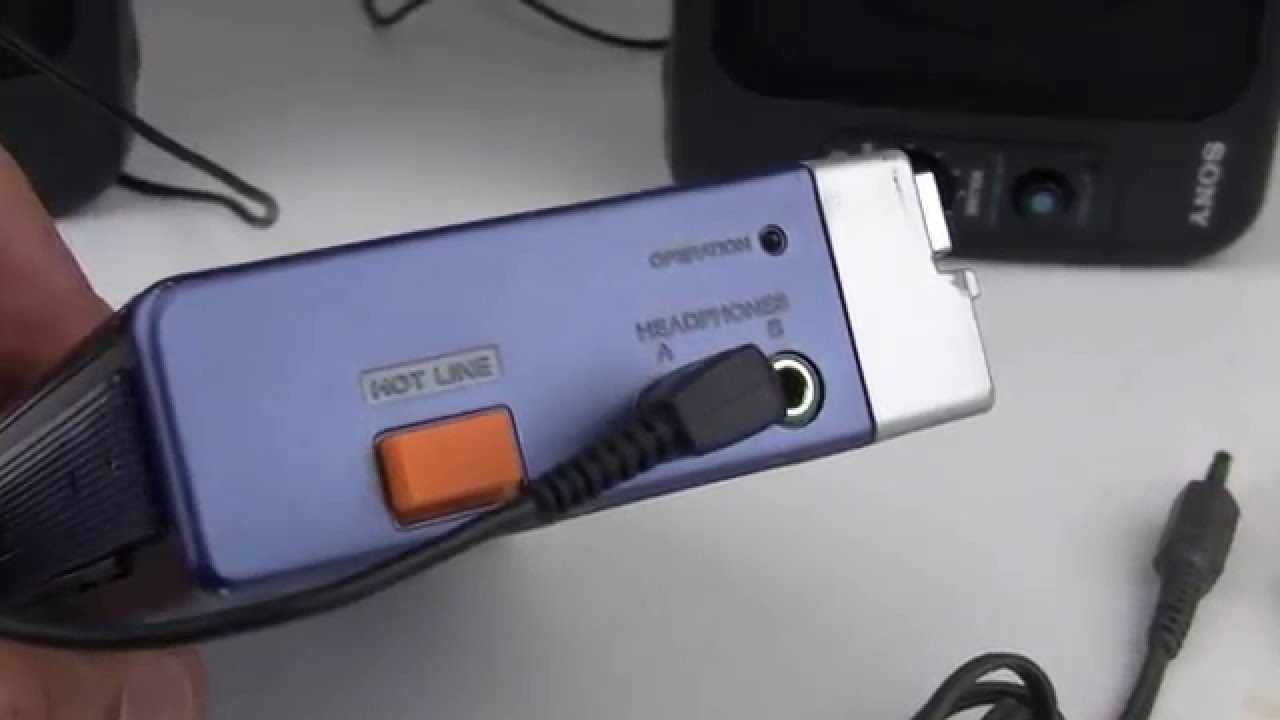
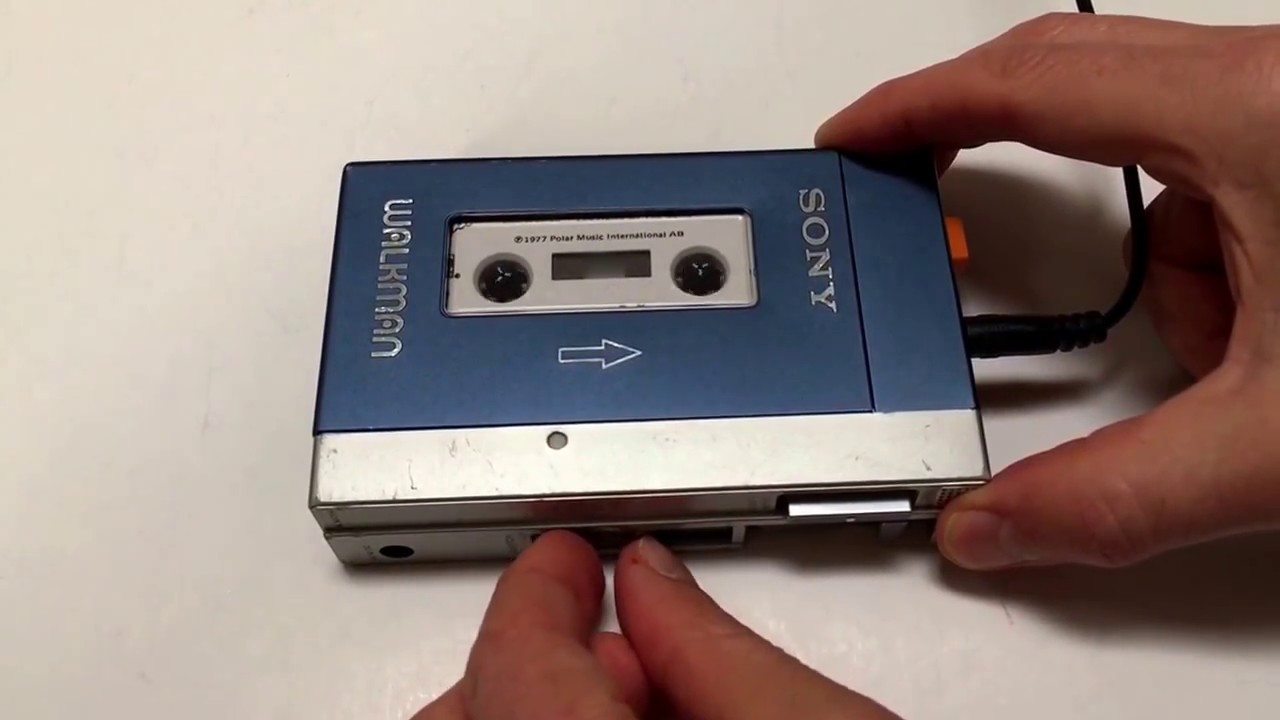
    So I found the original Sony Walkman, TPS-L2 , you know the one Starlord likes to listen to yacht rock on. Ive popped in some fresh double AA’s and I’m ready to pop open may old cassette collection.  First thing I notice on this is as I insert my Batman forever sound track cassette and press the rewind button to U2’s Kiss me , Kill Me, Thrill Me,  is that it has 2 headphone jacks.

    Living in a world today where all the tech companies are trying to steal my headphone jacks away, this makes me smile. The TPS-L2 does not have a record option, there is also a hotline button. Hotline button activates a builtin microphone. This did come in handy from time to time. However to record music on to a tape portabley was a whole nother problem. You had to hold the microphone up to the music, the sound quality was awful. You got all the surrounding background noise while trying to record a bootleg copy of the new New Kids on the Block cassette..


    The Final Thought

    Its simple, Its Timeless. This  belongs in every time capsule from 1979 till the day societies forget about time capsules. It opened music up to place and routines it didn’t quite fit before. Time would take several decades for this magnificent device to be faded out to an ipod. It saw many glorious changes, adaptations and complete evolutions. Who remembers the grandchild of the Walkman, the skipping prone Discman. It will forever be a classic. This helped make us all think the 80’s where a wonderful time to be alive.


  • Tech Throwback: The Newton

    Tech Throwback: The Newton

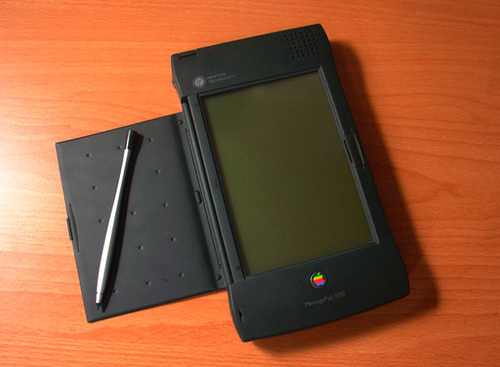
    I like to take a look at where I’ve been to evaluate where Im going. Technology is cyclical after all… wait no its not. That said I still like all the feels that come rushing back like a flood of nostalgia every time I get my hand on the tech I grew up with. Im going to go back periodically and take a looking at the stuff that used to blow our hair back and get our minds rolling. Some of these device blew up and changed the world, some where ahead of their time and some just fell flat and became colossal failures. Today I’m powering up the old Apple Newton..


    Give Me The Back Story

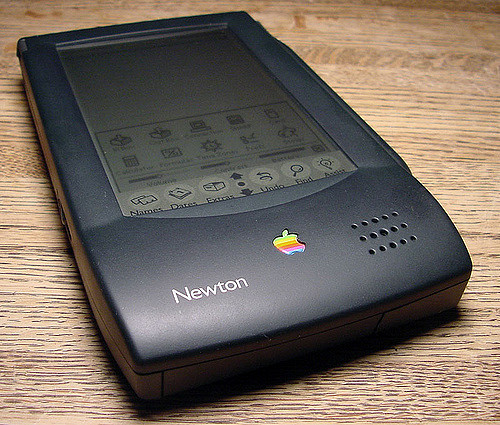
    The Newton is a series of personal digital assistants, PDAs as i like to call them, But that term wasent used and adopted till years after the Newton. It was developed and marketed by Apple Computer, Inc. An early device in the PDA category – the Newton originated the term “personal digital assistant” – it was the first to feature handwriting recognition. Apple started developing the platform in 1987 and shipped the first devices in 1993. Production officially ended on February 27, 1998. Newton devices run on a proprietary operating system, Newton OS; examples include Apple’s MessagePad series and the eMate 300, and other companies also released devices running on Newton OS. Most Newton devices were based on the ARM 610 RISC processor and all featured handwriting-based input.

    The Newton was considered innovative at its debut, but it suffered from its high price and problems with the handwriting recognition element, its most anticipated feature. The handwriting software was barely ready by 1993 and its tendency to misread characters was widely derided in the media. I my hands on one the first time when I was 12, almost 35 years later im ready to dive back in.


    Powering this up, shocked it still works. picked this working newton off eBay, with the flash card and assured it would turn on for $150. Yes its abit much for the actual functionality but that is not why I bought it. The Nice this is it runs off of AAA batteries, got to change them pretty frequently and you lose all your data each time they die but I’m able to pick them up at any store so the device will never die completely.
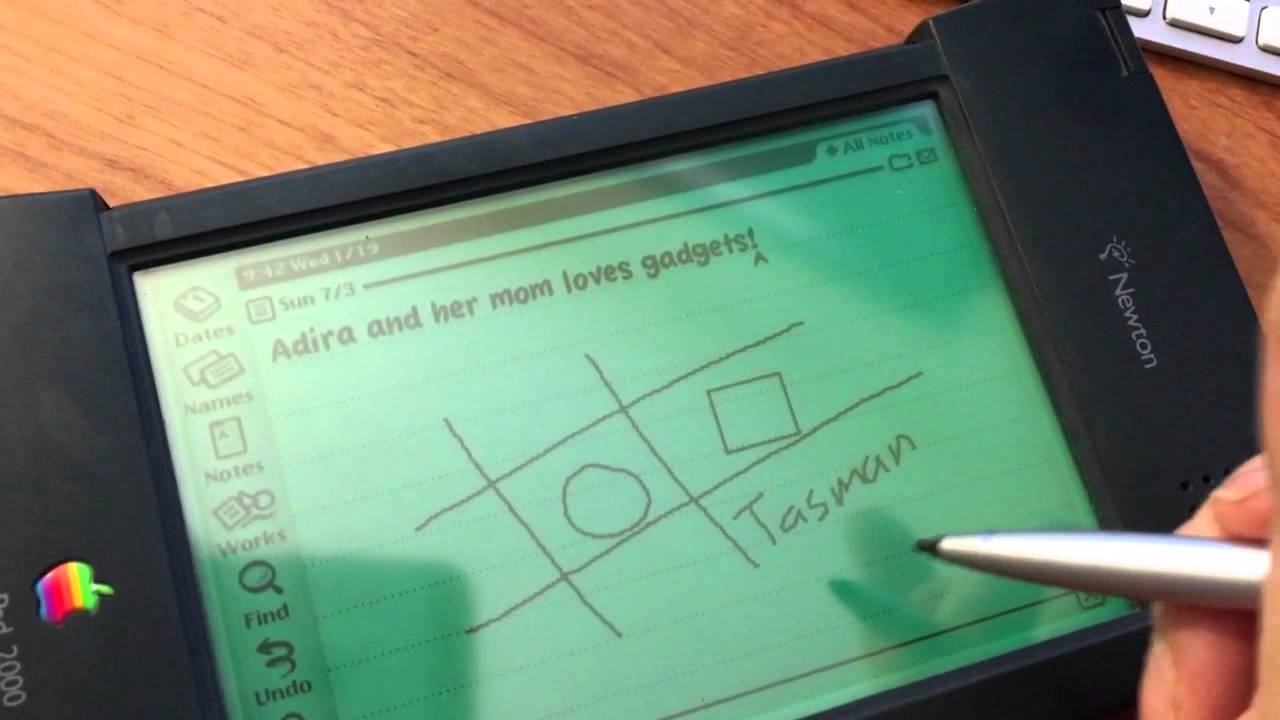
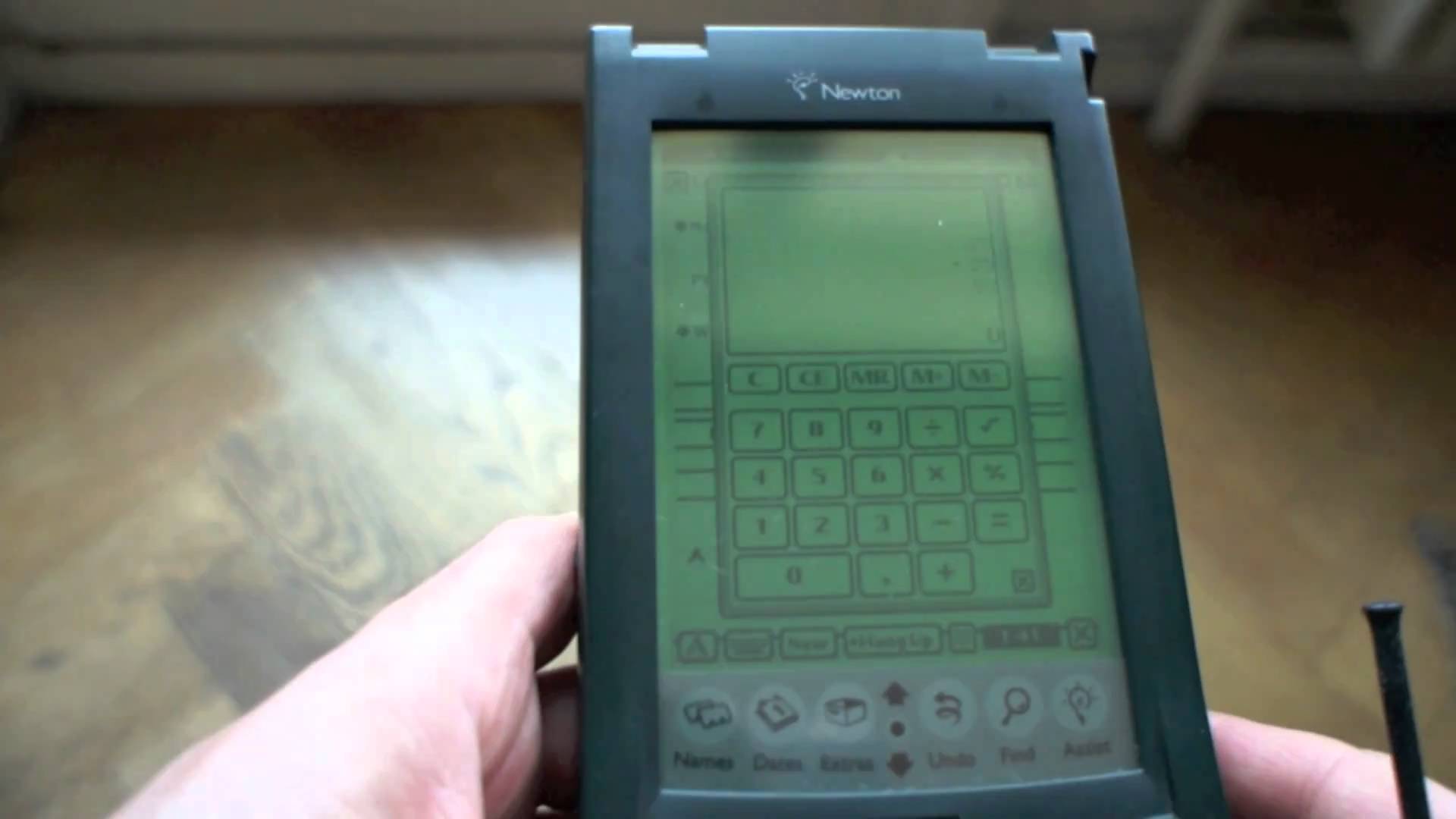
    Its pretty bulky I cant fathom how at the time they thought this was compact enough to carry around. its is a little over an inch thick and 7 inchs tall. Meanwhile I complain my phablet is to big.

    What’s This One Do

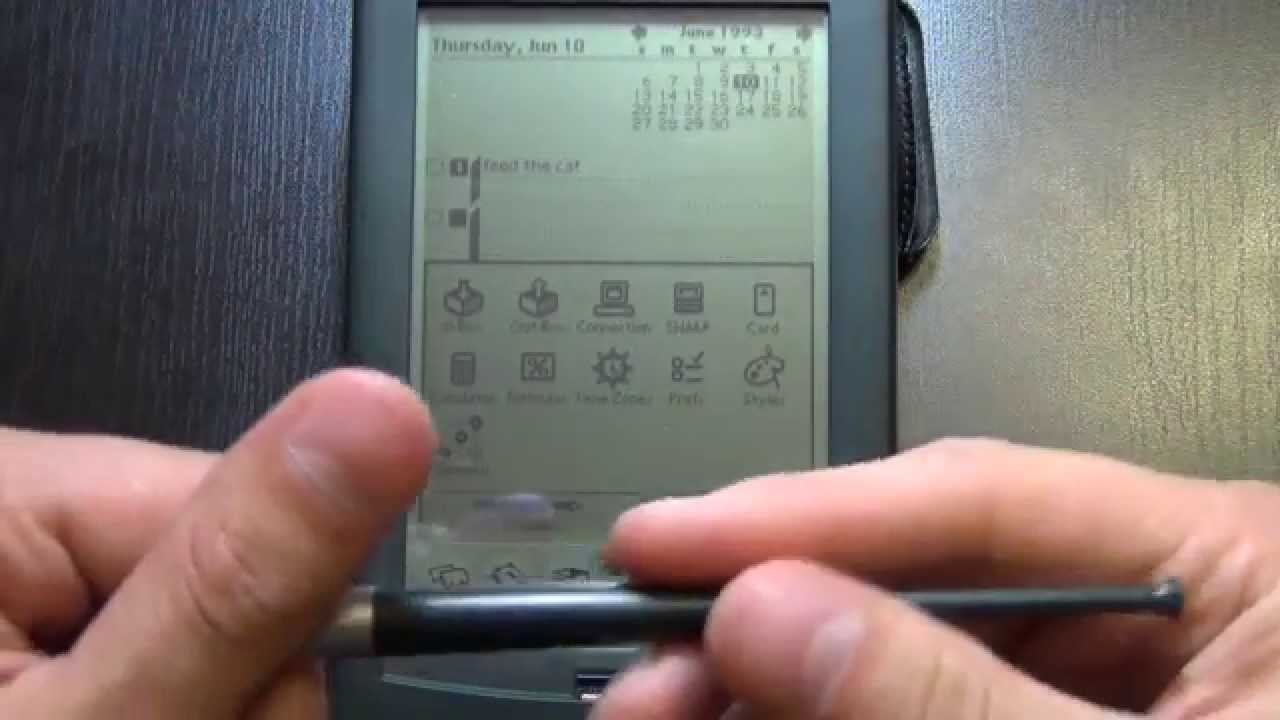
    It literally does nothing and I can barley see the green screen, its only functions are a contacts applications and a notepad,  a calendar,  calculator, currency converter and a timezone map. All the things I use on a daily bases, would be completely useless with out, and take for granted on a daily bases.  I do remember being able to get software application for it on a 3.5 floppy disk though.

    You can get up to a 4mb flash memory card for storage to prevent the battery erasing issue, a 4 mb card would store about 200 note, 250 contacts, 500 calendar events.  I do have to note that the flash memory seriously slowed down the processing power. So about 3 weeks worth of info for me.

    As much as I’ m laughing at this technological failure, it truly was ground breaking and revolutionary. We would see viable tech like it for almost 10 years and even still they hadn’t made much advancement on it. It really was ahead of its time and paved the way for the iPhone that would be released 20 years later. It was the first affordable device to compute handwriting, the first pocket touch screen, we still weren’t seeing full sized touch screen and wouldn’t for many years.  I think the commercial failure of this device dragged technology back a decade and had it been a corporate success who know where we would be today.


    The Final Thought

    Its magically revolutionary and fantastically simple. Its is the true prototype of our world today, it set the table for us and we ignored it. If Apple could have just crammed in a beeper, we could have had a primitive text messaging device. Im keeping it and will put a back up of info on it just in case of a tech apocalypse.