Category: News

  • Top Ten Things We Want to See at E3 2018

    Top Ten Things We Want to See at E3 2018

    It’s almost that time again. E3, the biggest conference for gaming news, starts on June 12th, and runs through the 14th. What kinds of news can we expect from the big three console makers? And what news will break from third party developers? Buckle up and get ready for a one-way ride to hype town, because we’re counting down our biggest E3 wishes! 

    Rocksteady Superman 

    Photo Credit: Comic Vine 

    Rocksteady, the developers behind the phenomenal Batman: Arkham series, have been rumored to be working on a Superman game. Such a project may well represent a chance for the big blue Boy Scout to finally star in a good open-world video game.  

    After seeing what Rocksteady could do for the Caped Crusader, it’s exciting to think about how they could handle Superman. Free-flying through Metropolis, beating up bad guys and saving the innocent? Sounds like a recipe for an awesome adventure! Here’s hoping it doesn’t play anything like Superman 64… 

    Fable 4 

    Photo Credit: Game Skinny 

    There are rumors circulating that a reboot of the storied Fable franchise might be on the way. An announcement at E3 would be met with trepidation by some, and joy by others. Lionhead Studios, the team responsible for the series, was shuttered back in 2015. This came after a series of downright awful Fable titles that experimented with the series’ direction. Namely the disastrous “Fable: The Journey,” an on rails (!) shooting game (!!) that was played with Kinect (!!!). 

    However, Microsoft would be handling Fable 4’s development in-house. If they stick to the RPG roots the franchise was founded on, it could be something truly exciting for the struggling Xbox brand. Fingers crossed that Microsoft learns from past mistakes made with the franchise and just makes a freaking RPG. If this one even mentions the word Kinect, I’ll be disappointed. 

    Borderlands 3 
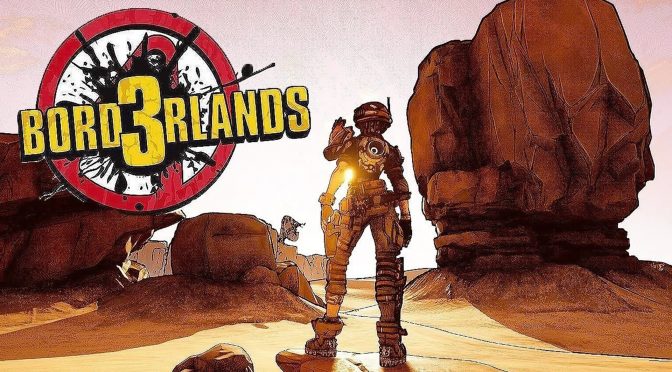
    Photo Credit: DSO Gaming 

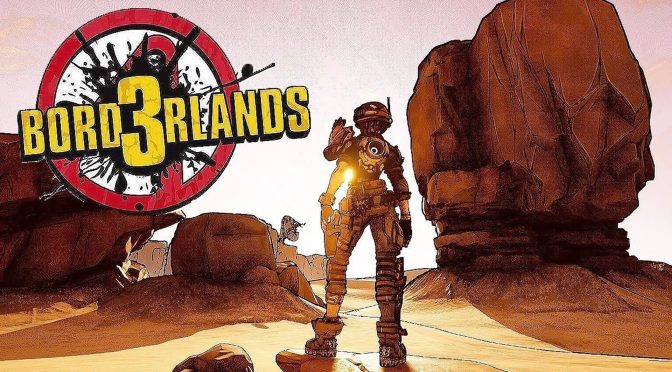
    It’s been rough for Gearbox lately. Their foray into the hero shooter genre, Battleborn, was absolutely trounced by Blizzard’s Overwatch. While Battleborn was quirky and cool in its own ways, it was unfavorably matched up against Blizzzard’s smash-hit. That’s in the past now, though, and Gearbox can push forward with their flagship franchise: Borderlands. The famous frenetic shooter was a smash-hit for Gearbox back in 2009, and its sequels were fantastic.  

    Borderlands: The Pre-Sequel, the last entry in the looter-shooter franchise, came out in 2014. In the meantime, the gaming world has changed pretty tremendously. Here’s hoping Gearbox sticks to their guns (ha) on this one and makes a solid Diablo-like shooting RPG. If they try to go toe-to-toe with Fortnite and make this one a battle royale I might scream. Gearbox, come on, guys: do what you’re best at! 

    Elder Scrolls VI 

    Photo Credit: GamingScan 

    With the exception of Elder Scrolls Online, we haven’t seen an Elder Scrolls game since 2011’s Skyrim. Many single-player RPG fans have been clamoring for another entry in the open-world series. While Bethesda has been experimenting with spin-off card game titles and their MMO, they’re clearly still dedicated to their core games.  

    Odds are pretty good we’ll see at least a trailer or some gameplay footage from a hypothetical new Elder Scrolls. However, some of Bethesda’s other franchises like Prey or Doom might be receiving the next full-game treatment. If so, we’ll be sure to see them at E3. With luck, we might just see one of those in addition to a new single-player Elder Scrolls!  

    Next Gen Systems from Sony and Microsoft 
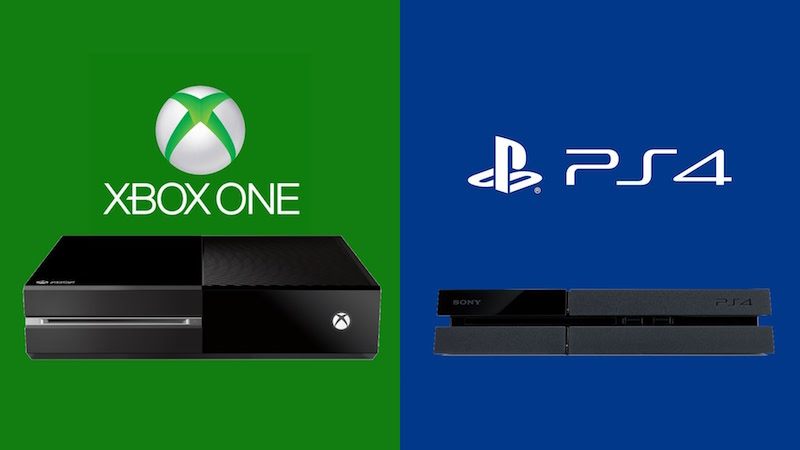
    Photo Credit: NDTV Gadgets 

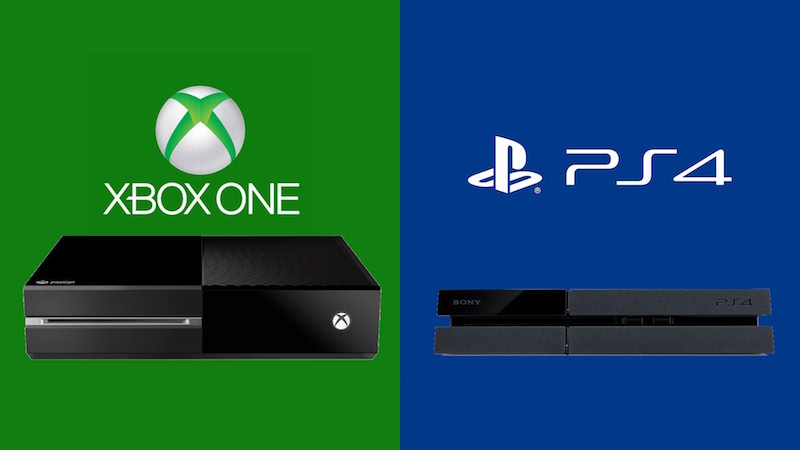
    The Xbox One and PS4 are five years old now. There’s definitely some speculation that Sony and Microsoft might be showing off some new hardware at this year’s E3. If so, pricing, graphical capabilities and exclusive games will certainly be the topic of conversation.  

    However, it is worth noting that the Xbox One X and the PS4 Pro were recently released. This might give a bit of extra life to the aging systems. However, with the Nintendo Switch only recently being released, it might be wise of the other two console makers to fast-track their follow ups.  

    Star Fox 

    Photo Credit: DeviantArt 

    Star Fox is one of Nintendo’s flagship franchises, but it’s had a bit of a rough patch lately. The unusual and pervadingly awkward Star Fox Zero has somewhat sullied the franchise. However, rumor has it that a racing game like F-Zero is in the works with the Star Fox cast. This would be more than a little odd, but it would be interesting.  

    Nintendo hasn’t released an F-Zero title in America since 2003. Seeing it live on, even in spirit, would be great. I would definitely rather see a new F-Zero than see Star Fox become a racing game, I wouldn’t dismiss it out of hand. Hopefully, though, the rumor is empty, and we’ll see a real follow-up to 2006’s fantastic Star Fox: Command. Either way, expect to see something from Star Fox at E3! 

    Fire Emblem 

    Photo Credit: Wikimedia Commons 

    Fire Emblem, once circling the drain and ready for cancellation, is now one of Nintendo’s biggest franchises. Buoyed tremendously by its characters appearing in Super Smash Bros, Fire Emblem is an example of the latter franchise’s propensity for playing king-maker.  

    Announced at last year’s E3, the Switch version of Fire Emblem is likely to be part of Nintendo’s June 12th presentation. The Switch is a perfect fit for the franchise: console releases like Path of Radiance have delivered huge, gorgeous maps. Handheld releases like Awakenings have delivered deliciously-difficult strategy on the go. Marrying these two aspects of the franchise is a match made in heaven. If Nintendo releases this game in the same window as Pokemon and Smash Bros, it’s going to be a very good year for gamers. 

    Gears of War 5 (Or Really Any Xbox Exclusives) 
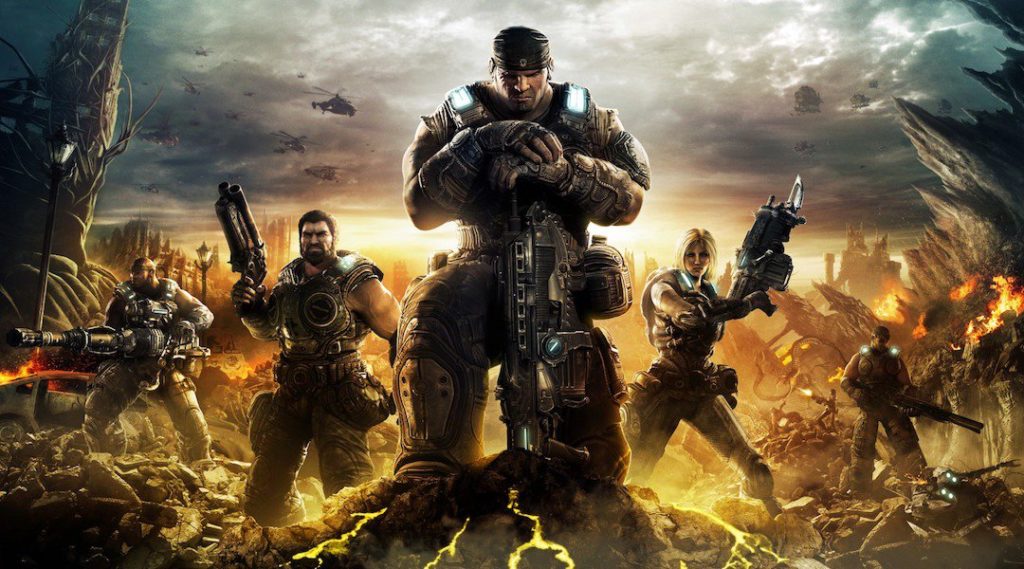
    Photo Credit: Game Rant 

    The Xbox One isn’t doing too well when compared to the PS4 and the Switch. A lot of momentum Microsoft carried into this console generation was wrecked by their awful DRM policies when the system was announced. Following the abysmal reaction to the announcement, early games on the system were plagued by network issues and bugs. Notably, the Master Chief Collection, a game that should have been an easy home run for the company, was bungled out of the gate and nearly unplayable.  

    Needless to say, Microsoft needs some wins. While they’re in no danger of going out of business or anything (hello, Windows), they do run the risk of becoming irrelevant. Sony does everything Xbox does, but with better graphics and better exclusives. At least, for now. Maybe Microsoft has some heavy hitters up their sleeve for E3. Maybe something like… Gears of War 5? Alright, I guess Gears games are cool. Maybe try somehting new, guys? Oh well, time will tell. 

    Pokemon 

    Photo Credit: Den of Geek 

    It’s absolutely astonishing that it took this long for a core Pokemon game to make it to home consoles. It’s almost funny: Nintendo had to make a hybrid console to finally maneuver Game Freak into making a Pokemon for one of their home consoles. In any event, the internet is collectively abuzz with hype for this release. This one is guaranteed money for Nintendo if they just put in a few much-demanded features.  

    A “pro” mode where they don’t teach you how to throw a damn Pokeball would be cool. Let my Pokemon follow me around in the overworld. Give me a 3D, over-the-shoulder camera. Little things, man. You guys should knock this one out of the park. Hell, Game Freak already made 1080p 3D renders of the entire Pokedex for X and Y. (Don’t believe me? Emulators can extract those models, and they’re gorgeous.) Fingers crossed that we see a lot of this one at E3. 

    Most Hyped Game of E3: Super Smash Bros 
    Photo Credit: Screen Rant 

    Nintendo set the Internet ablaze when they announced Smash Bros for Switch at the end of their March Nintendo Direct. This series has achieved legendary status among Nintendo fans. Smash Bros singe-handedly ignited interest in the Fire Emblem series in the US. Characters included in this fighting game’s roster become instant icons. The promise of Smash on the go on a big, gorgeous Switch screen is a huge one. Two-player fighting in table top mode with split Joy Cons! Huge LAN-style parties with linked Switch systems! The Switch was seriously made for Smash. 

    Nintendo likely plans to launch their paid online service alongside Smash, so we’re likely to see it in September. I don’t think there’s another game that deserves as much attention at E3 as Smash. Seriously, any information Nintendo gives during their E3 Direct will be dissected, obsessed over and talked to death in the months before the game finally drops. Hopefully we can all keep our hype contained in the meantime. 
  • Steam Link iOS App Blocked from Release

    Steam Link iOS App Blocked from Release

    Steam Link, Valve’s game streaming app, has been blocked from release by Apple, Valve claimed in a statement to Ars Technica. The app, which can stream PC games to a separate device on the same Wi-Fi network, was blocked due to “conflicting with app guidelines,” according to Apple. 

    Why Was it Blocked? 

    The answer to that question is somewhat unclear. Perhaps Steam Link’s ability to stream games purchased through Valve’s Steam store didn’t comply with Apple’s guidelines. Apple requires a thirty percent share of every in-app purchase. This may have conflicted with the way Valve presents the Steam Link service. 

    Valve claimed in their statement that “the Steam Link app simply functions as a LAN-based remote desktop similar to numerous remote desktop applications already available on the App Store.” The decision was appealed, but the appeal was dismissed by Apple.  

    So No Steam Link on iOS? 

    Valve expressed their hopes for Apple to reconsider their decision in the future. As such, it’s not impossible that there may be a Steam Link on iOS someday. However, for the time being, the app remains blocked from release. Perhaps the two companies can work out a deal in order to greenlight the app. 

    While the app definitely competes directly with one of the App Store’s biggest revenue streams: games. Allowing users to stream games from their PC from a free app may have been a step too far for Apple. It seems the phone giant would rather be the big fish in a small pond in this fight. Allowing Valve to offer a free app for game streaming could have been seen as too big a threat to their games sales. 

    What if I Want to Stream to My Phone? 

    While the app was blocked from iOS, it is available on Android devices. While this is no help for iPhone users, it might convince those on the fence to switch to Android. Other alternatives include Steam’s Big Picture Mode, which allows users to play their Steam Library on a TV screen. In any event, it doesn’t seem Valve will be too badly hurt by Apple’s snub. Steam made $730 million dollars in 2014 alone, according to PC Gamer. 

  • Nintendo Begins Selling Switch Without Docks… In Japan

    Nintendo Begins Selling Switch Without Docks… In Japan

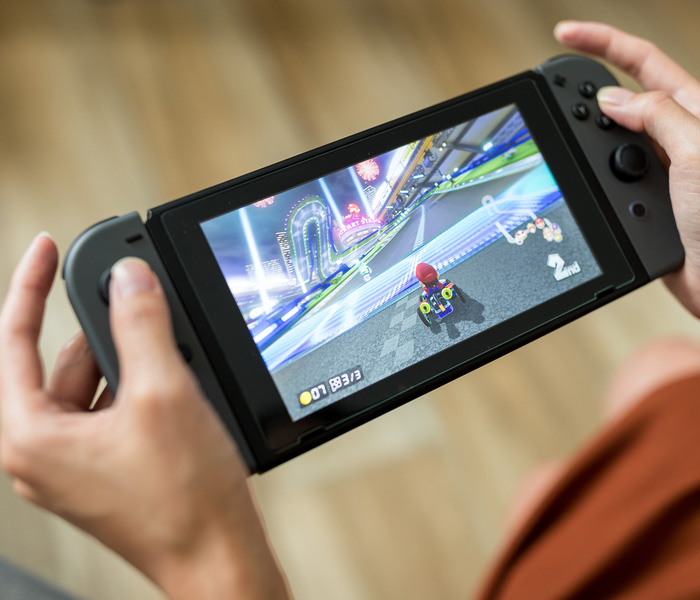
    In a move to outfit even more households Switch owners, Nintendo has started selling dock-less Switches in Japan. The “second Switch” version of the console is markedly cheaper than the standard retail version, going for ¥24,980. That’s about $220 in USD. How does this version stack up? 

    What’s in the Box? 

    By spending a little less, you get just the Switch, Joy Cons and Joy Con Grips. You don’t get the Comfort Grip, also affectionately known as the Dog Bone, which is something of a bummer. As we said, this version also doesn’t have a dock, which means it doesn’t have an HDMI cable either.  

    Oddly, this version also doesn’t include a charging cable. If you want to charge it, you’ll have to either use someone else’s dock or a standard USB-C cable. Be wary when using non-Nintendo cables, though, as the Switch is infuritatingly not USB-C compliant. We’d hate to see someone brick their switch just trying to charge it! 

    Who is This For? 

    Nintendo seems to be primarily marketing this device at people who already live with a Switch owner. Since it doesn’t even come with a charger, this version is clearly aimed at those who could use someone else’s dock.  

    The hybrid console has some users (about 20 percent) who elect to use it primarily as a handheld gaming device, forgoing the dock altogether. Those users would benefit from the cheaper price and lack of included dock as well. 

    Dockless Switch Coming to the US? 

    While this definitely seems better suited to the Japanese market than the American one, Nintendo may be able to benefit from releasing it here. For one, users who already have a Switch (and thus, a dock) would be able to get it for loved ones. Birthday presents for kids, gifts for spouses, etc., would be more palatable for some at a cheaper price.  

    Secondly, users who are uninterested in using the Switch as anything other than a handheld aren’t unheard of. If said users already have a USB-C cable and are wary of the Switch’s specifications, this could be an ideal budget entry to the system for them. Not to mention, users could later pick up a dock by itself from Nintendo.  

    Maybe we’ll hear more about a potential American release around E3. Until then, if you want a cheaper console with no dock, you’ll have to hit the secondhand market.  

  • No More Buttons? HTC U12 Plus to Use Haptic Feedback Instead

    No More Buttons? HTC U12 Plus to Use Haptic Feedback Instead

    In a move reminiscent of the iPhone 7’s home “button,” the HTC U12 is going to have pressure-sensitive areas shaped like buttons. The “buttons” will give a little burst of haptic feedback when “pressed,” simulating the action of a mechanical button. This is an interesting choice: reducing the number of moving parts certainly reduces the number of things that could become broken or damaged.  

    U12 Sporting 4 Cameras 

    Yeah, no joke! This sucker will have two cameras on the back and two on the front. This allows for a style of photography called “Bokeh,”a super artsy style of portraiture. It’s best described as a clear image in the foreground with a hazy, hipster-looking fade in the background. It’s the look all those Instagram-famous models have in their selfies.  

    The cameras also sport a 2x optical zoom, which is handy for snapping photos at a distance. Digital zoom is known for diluting the image, whereas optical zoom retains image quality over distance. 

    Main Squeeze 

    Much like the Google Pixel 2, the HTC U12 will recognize when it is squeezed as an input. The U12 will also be able to differentiate between short and long squeezes, as well as holds. These inputs can then be bound to different actions, such as opening the camera or turning on the flashlight. This functionality comes as no surprise, as HTC manufactures the Google Pixel. 

    The same technology that recognizes the squeeze input allows the phone to determine which hand it is being held in. It even has touch inputs on the sides to switch to single-hand mode, allowing for greater accessibility. 

    Modern, but Unique 

    The U12 will also sport a Gorilla Glass back, like many of its contemporaries, but without wireless charging. This makes its glass back primarily aesthetic, which is something of a bummer, considering how much more fragile it is. Again, most people will opt for a phone case, but it’s still not ideal to elect to make a fragile piece of technology even more breakable.  

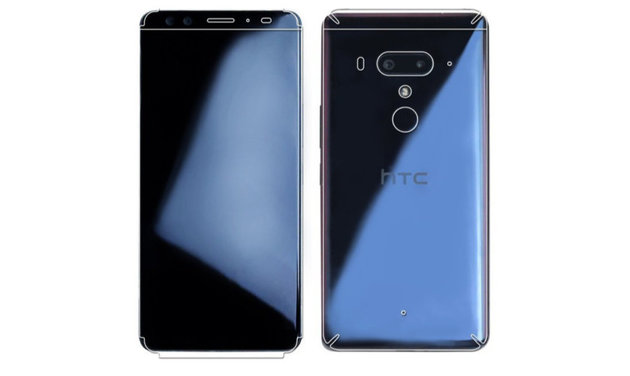
    HTC interestingly eschewed the notch design so common to premium smartphones these days. Instead they opted for a tall screen with very thin bezels at the top and bottom. This look sets it apart from phones like the iPhone X. The phone will be releasing sometime in mid-June. The 64GB version will retail for $800, and the 128GB version will be $850.  

  • Dell XPS 15 2-in-1 Features Unique Intel and AMD Partnership

    Dell XPS 15 2-in-1 Features Unique Intel and AMD Partnership

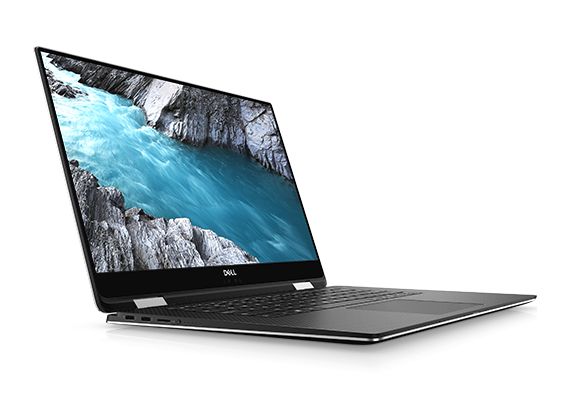
    Intel, maker of processors, and AMD, maker of graphics cards, have partnered to create an interesting feature. The Dell XPS 15 2-in-1 houses a part called the Kaby Lake-G. This part is a fusion of an Intel CPU and an AMD graphics chip. This has some significant ramifications for the computer it’s housed in. 

    Discrete vs Integrated Graphics 

    Most people who use a laptop for “normal” stuff, like writing and watching YouTube, aren’t concerned with their graphics card. Only high-end games and some professional applications require tremendous graphical computing power. However, those that want to play high-end games or use AutoCAD on their laptop tend to opt for discrete graphics cards.  

    Discrete cards are separate from the motherboard, allowing them more space to perform their advanced processes. They also put off tremendous heat, take up space and use more power. Integrated graphics, on the other hand, are processed in the same place as the motherboard. Integrated graphics are less expensive, less noisy and generate less heat. But they are also notably ill-equipped for gaming, as they are underpowered. 

    The Solution? A Compromise 

    Enter the Kaby Lake-G. While still technically a discrete graphics card, this processor is an interesting hybrid. The Kaby Lake-G is comprised of an Intel Core i7 (in high-end builds) and a Radeon RX Vega M GL GPU. In short, it’s a hybrid of two critical processors, linked to save space and energy and produce less heat. This kind of hybrid is perfect for small laptops and tablets to be able to put out graphics comparable to traditional gaming rigs.  

    XPS 15 2-in-1 Performance 

    Dell promises this new chip will perform at (or above) the level of current mid-tier graphics cards. This is a bold claim, considering how small the hybrid chip is. But given the nature of the cooperation between Intel and AMD, this might be true. If it is, this type of hybrid chip could be the future of gaming laptops. This technology would allow the computers to remain small and portable without sacrificing in computing power.  

    The XPS 15 2-in-1 itself is rather impressive, if a little noisy. While not exactly a gaming laptop, it can run games reasonably well. Considering how thin it is and how weird its graphics card is, it’s pretty impressive. Clocking about 45 frames per second at 1080p with little issue, this little 2-in-1 packs a lot of punch. 

  • Xiaomi Mi 8: Coming to America Soon?

    Xiaomi Mi 8: Coming to America Soon?

    You’ve certainly only heard of the Xiaomi Mi line of phones if you’re an avid follower of Chinese smartphone makers. Well, if you’re not in that (incredibly small) camp, you’re about to be: The Mi line of phones is one of the best budget smartphone lines out there. It’s comparable in a lot of ways to the phenomenal OnePlus line. What should expect in the Mi 8? And when should you expect it? 

    Xioami Who? 

    Xioami is a Chinese smartphone maker that specializes in affordable Android handsets. They have been incredibly successful in the Far East, rapidly becoming the largest Chinese smartphone maker. Backed by several generations of iterated smartphone technology, the company is now releasing the Xiaomi Mi 8 to coincide with their 8th anniversary. 

    Mi 8 To Come to America? 

    The Chinese phone maker has promised that this phone will be their first mass-market release in America. According to Xiaomi, who already sells fitness trackers and smart home speakers in the US, their smartphones will be coming State-side as early as late 2018, or as late as early 2019. This is exciting news for Android enthusiasts looking for affordable premium smartphones. 

    In the Meantime, 

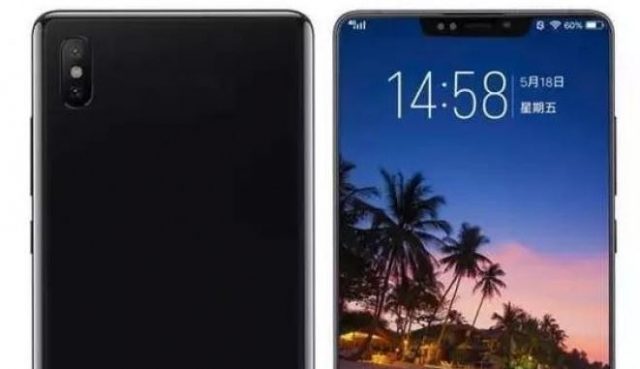
    The Mi 8 is set for a May 31st launch in China and is sure to make waves there. With their impressive track record and the phone’s impressive specs, it’s sure to impress. The phone sports a ton of advanced features, like an in-screen thumbprint scanner, wireless charging, a huge six-inch screen and 3D face scanning. All that, and it still costs about $450. Here’s hoping this little wonder comes to the States here soon! 

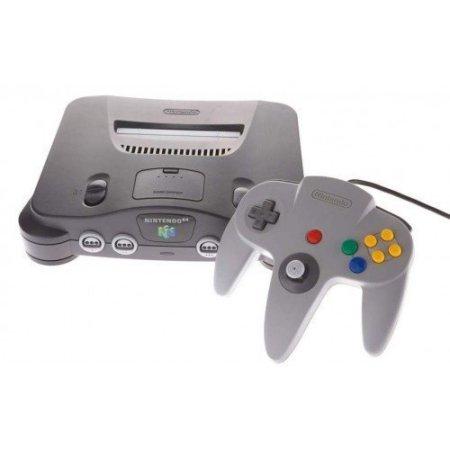
  • New Trademark Suggests Nintendo is Working on N64 Classic

    New Trademark Suggests Nintendo is Working on N64 Classic

    After the resounding success of the NES and SNES Classic systems, it comes as no surprise that Nintendo would push forward with more mini classic systems. Nintendo has filed a trademark that suggests they may have plans to create an N64 Classic system. This is exciting news, especially given the recent news that the Switch will not have a Virtual Console. 

    Everything Old… 

    The NES and SNES Classic systems sold out on their first productions, proving to be wildly successful. Nintendo surely seeks to emulate that success with their next mini console, but there are still some questions.  

    Will supply finally meet demand? Thankfully the original two classic mini systems are getting reissues in late June, so maybe Nintendo has learned their lesson? The other pressing question is, which games would an N64 Classic even have? 

    …Is New Again 

    Rare, the company responsible for Banjo-Kazooie and Goldeneye 007, is now owned by Microsoft. This could lead to some odd inclusions for games for a potential N64 Classic. Nintendo famously was the main developer releasing quality titles for the system: most of the great games were either first party or Rare.  

    If Nintendo is able to secure the rights to re-release Rare’s games, the system could have an amazing library. Thankfully, Microsoft has shown willingness in the past to work with Nintendo over older Rare games.  

    When Might We See the N64 Classic? 

    It seems unlikely that the system would be out anytime in 2018. Nintendo is already set to have a big Fall season. Super Smash Bros and Pokemon for are both confirmed for this year. However, the yearly games conference, E3, is in a few weeks. We’re likely to hear news of a new Classic system there first, even if it is just an announcement and a teaser. We’ll likely even see a release window, if the system materializes. We’ll have to wait and see what the big N has in store! 

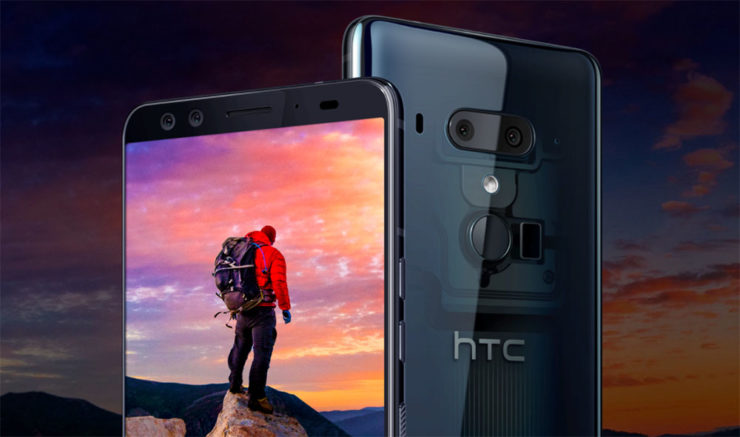
  • HTC U12 Plus, What We Know so far

    HTC U12 Plus, What We Know so far

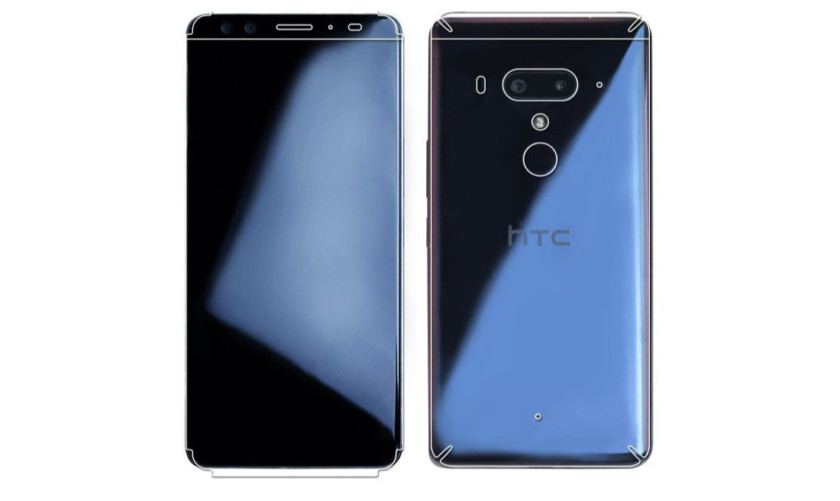
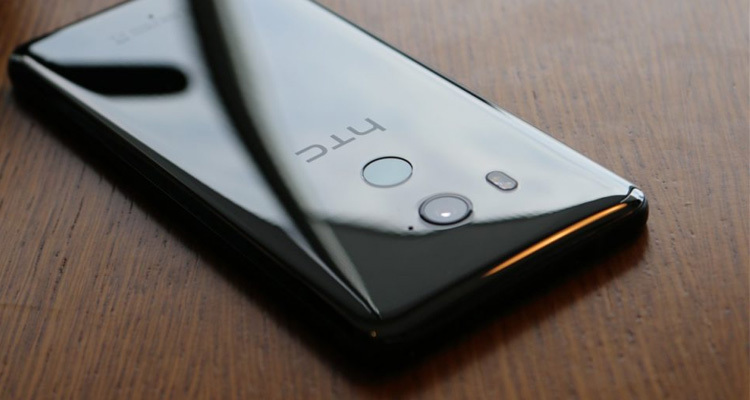
    HTC’s latest flagship has arrived! On top of new cameras and a full screen without a notch notch, HTC has created a phone is literally more sensitive than ever. This is the HTC U12 Plus. The HTC U12 Plus gives a great first impression, at least when it comes to design. Almost every modern flagship is made of glass panels held together by a metal frame, but HTC’s design feels sturdy with an almost brick-like heft to it. HTC may have changed designs over the years, but the build quality continues to be excellent. The new phone still manages to retain some of HTC’s signature style, so you won’t mistake it for anything other than an HTC.


    HTC U12 Plus comes with a 6.0-inch Quad HD+ display with no notch and thin bezels. That Super LCD 6 display is protected by a custom layer of Gorilla Glass that’s actually closer to Gorilla Glass 3 than 5. Gorilla Glass 3 is harder than 5, so it will likely be more difficult to scratch. Ill be the judge of that, grabs keys. As for software, it’s running Android 8.0 Oreo. Even though Android 8.1 has been out for five months, HTC still couldn’t manage to load up the latest version of Android on its new smartphone.

    The U12 Plus seems to be a big upgrade over its predecessors, at least on paper. It sports a 16MP wide-angle lens and a 20MP telephoto lens around back, while the front has two 8MP cameras. The U11’s camera was one of the best of 2017, so we’re really excited to see the U12 Plus

    HTC continues its minimalist Liquid Surface design language, giving us a beautiful glass design with IP68 water resistance.I would have liked to see a few more changes, the HTC U12 Plus is still a gorgeous device. We also have to applaud HTC for resisting the notch, something many other 2018 flagships are now rocking. Instead of physical keys, they are now pressure-sensitive. While these buttons may not provide a physical click, they do provide haptic feedback to let you know they’ve been triggered.

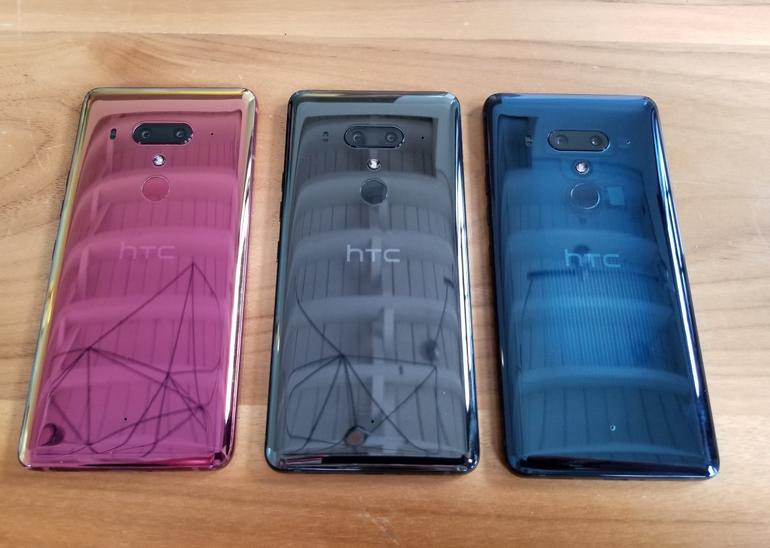
    The Colors for HTC U12

    The HTC U12 Plus will be available in ceramic black, translucent blue, and flame red.

    The ceramic black (known as titanium black in some markets) is probably the least exciting of the three options, but that’s not to say it looks bad. It’s a shiny, reflective, and polished glass option that is actually more gray than black.

    The translucent blue model is partially see-through, allowing you to see some of the internals. It isn’t quite on the level of a clear case, but it is still pleasantly unique.

    Finally there’s the flame red variant. This model has an eye-catching sheen that seems more pink than red. Unfortunately, the flame red won’t be available immediately at launch.

    Quick Spec Look

    • Display 6.0-inch Super LCD 6 2,880 x 1,140 resolution 537ppi
    • 18:9 aspect ratio
    • DCI-P3, sRGB
    • SoC Qualcomm Snapdragon 845 Mobile Platform
    • 2.8GHz, 64-bit octa-core
    • GPU Adreno 630
    • RAM 6GB
    • Storage 64/128GB
    • MicroSD expansion up to 2TB with Flex Storage
    • Cameras Rear cameras
    • Primary: 12MP wide-angle HTC UltraPixel 4 sensor, ƒ/1.75 aperture, 1.4μm pixels
    • Telephoto: 16MP sensor, ƒ/2.6 aperture, 1.0μm pixels
    • Phase detection and laser autofocus, OIS, HDR Boost 2, dual-LED flash
    • Front cameras
    • Dual 8MP sensors, ƒ/2.0 aperture, 1.12μm pixels, wide-angle with 84-degree field of view
    • Audio HTC USonic with Active Noise Cancellation
    • HTC BoomSound Hi-Fi edition
    • Hi-Res audio recording
    • Hi-Res audio certified
    • Qualcomm aptX HD, LDAC up to 32-bit high-resolution wireless audio via Bluetooth
    • Battery 3,500mAh
    • Non-removable
    • Qualcomm Quick Charge 3.0
    • IP rating IP68
    • Sensors Edge
    • Ambient light
    • Proximity
    • Motion G-sensor
    • Compass
    • Gyro
    • Magnetic
    • Fingerprint
    • Sensor hub for activity tracking
    • GPS, AGPS, GLONASS, Galileo, BeiDou
    • Network 2G/2.5G GSM/GPRS/EDGE
    • – 850/900/1800/1900MHz
    • 3G UMTS
    • – AWS/850/900/1900/2100MHz
    • – HSDPA 42, HSUPA 5.76
    • 4G LTE
    • – FDD: Bands 1, 3, 4, 5, 7, 8, 12, 13, 17, 20, 28, 32, 66
    • – TDD: Bands 38, 39, 40, 41
    • – Support Cat 18 Gigabit LTE: downloads up to 1.2Gbps, uploads up to 150Mbps, up to 5CA and 4×4 MIMO (where supported
    • – VoLTE and Wi-Fi calling (where supported)
    • Connectivity USB 3.1, Type-C
    • Bluetooth 5.0
    • Wi-Fi 802.11 a/b/g/n/ac (2.4 and 5GHz) with MU-MIMO
    • NFC
    • DisplayPort over USB Type-C
    • HTC Connect
    • AirPlay, Chromecast, DNLA, and Miracast
    • Software Android 8.0 Oreo
    • Dimensions and weight 156.6 x 73.9 x 8.7-9.7mm

    The Final Thought

    We got some movement from HTC. This is good. Any signs of life from the once dominant smartphone aficionados is good. Ive always said that HTC is for the high end smartphone user, not the everyday Eddie. The produce a high-end classy flagship smartphone that always goes under appreciated. Im sorry I just miss my HTC one..

  • Apple Privacy Website with All of Your Data

    Apple Privacy Website with All of Your Data

    Apple doesn’t know me, they only think they do. That’s what Id like to think anyhow, but now I can know what they think they know.  Now Apple is the latest tech giant to make changes to comply with GDPR, the EU’s privacy data rules, after it introduced a new website that shows customers exactly what personal data it holds on them. Apple has today launched its new Apple Privacy Website , allowing Apple users to download everything that Apple personally associates with your account, from Apple ID info, App Store activity, AppleCare history to data stored in iCloud like photos and documents. This is currently only available for European Union accounts, to comply with GDPR, and will roll out worldwide in the coming months.

    How To Access The Apple Privacy Website

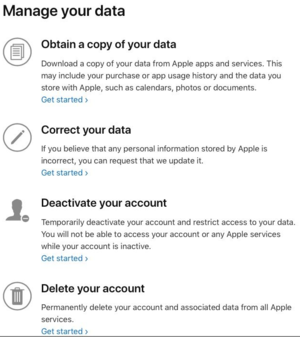
    This link to get to  Apples Privacy and Data link is here: https://privacy.apple.com/. Just login in with your apple ID. There are simple shortcuts to updating your info, temporarily deactivating your account and options to permanently delete it. Here’s how to do it …You can request account details and sign-in records and data such as contacts, calendars, notes, bookmarks, reminders, photos and documents.

    1. Go to Apple’s new Data and Privacy website;
    2.  Log in with your Apple ID. (for now, the privacy info and downloads work only for users in the European Union, Iceland, Liechtenstein, Norway, and Switzerland);
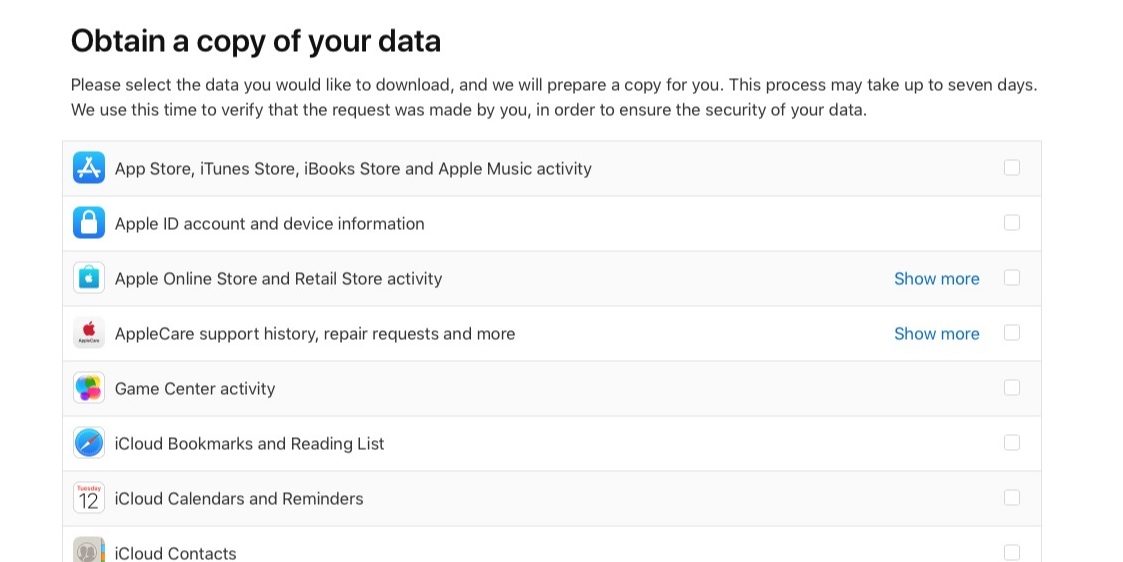
    3.  Click on the “Get started” link below the header “Obtain a copy of your data,” and check “Select all,” or tick the individual options boxes;
    4.  Select a maximum file size, and Apple will split things into the chunks you choose;
    5.  If you want a copy of your iCloud-stored media, e-mails, or Drive content, the process will obviously take longer, but Apple says the gathering can take up to two weeks anyway;
    6.  When everything is ready, you will get a mail from Apple that your personal data is ready to download, and if you don’t do it, Apple will erase everything in two weeks.

    Things To Consider

    Dependent on the data records selected, Apple may take as long as two weeks to assemble the information. While the company did say the data will be deleted after two weeks. The data site also gives users the option to correct data, deactivate their account and delete all information held by Apple in compliance with GDPR. Only data that is personally identifiable can be found here. I think this can all be downloaded with a few simple clicks on the privacy portal. Note data like iCloud Photos will take a long time to generate. There are potentially tens of gigabytes of files on there.

    The Final Thought

    Just imagine if your bank, credit card company, ISP, or big-box retailer gave you the right to look at your data! It’d be a different world. George Michael, I mean Maharris promised us this a few years ago with his FaceBlock app. I wonder what happened to that.  What we really need is transparency and openness and there’s nothing to fear in providing this to users. It need not be forced through regulation, but standard basic practice from the outset. This is the simple easy solution to our data privacy issues. The Apple Privacy Website is a big step to where we should be. Just let us know what you think you know.

  • Mobileye Self-Driving Car Runs Red Light During Demonstration

    Mobileye Self-Driving Car Runs Red Light During Demonstration

    Is a complex mathematical treatise a sufficient substitute for real-world safety testing? Israeli company Mobileye, owned by Intel, is seeking to show that its unique approach to self-driving cars is more practical and effective than methods employed by companies like Waymo. Their CTO, Amon Shashua, wrote in a blog post in October: “We target a vehicle that gets from point A to point B faster, smoother, and less-expensively than a human-driven vehicle; can operate in any geography; and achieves a verifiable, transparent 1,000-times safety improvement over a human-driven vehicle without the need for billions of miles of validation testing on public roads.” Is this likely, or are these bold claims by the unorthodox company? 

    Mobileye’s Self-Driving Cars 

    While most self-driving cars rely heavily on lidar and radar systems in order to read their surroundings, Mobileye favors an all-camera set up. According to Mobileye, their self-driving cars use cameras to make a 3D model of the real world and then use software to decide what to do with that information. This is in contrast to other, more conventional vehicles in this same industry that don’t rely on cameras alone.  

    Sensor Fusion as An Alternative? 

    “Sensor fusion,” a process by which a self-driving car could be made to use both cameras and lidar, is an end goal for Mobileye. Whether their proposed method of designing these cars will work or not is uncertain. Recent demonstrations have shown Mobileye-powered cars even speeding through red lights, which is more than a little troubling.  

    It would seem that Mobileye has banked heavily on sensor fusion being a foolproof way to ensure their vehicles are safe. This rides on the assumption that cameras will only fail in situations that lidar will succeed in, and vice versa. However, this assumption itself seems erroneous: what about situations where neither sensor works? Not to mention the hassle of coding to get the two sensor types to cooperate. And, as every programmer knows, the more lines of code something has, the more likely it is to have bugs. 

    Responsibility-Sensitive Safety 

    Where Waymo and similar companies prefer hours of real-world road testing for safety, Mobileye has shown a desire to prove their cars are safe via math and statistical models. Mobileye has even gone so far as to create a Responsibility-Sensitive Safety, or RSS, model that attempt to mathematically quantify all the ways a vehicle could be at fault in an accident. By putting this RSS model in all their vehicles, Mobilieye claims it would then be impossible for them to be at fault in an accident. 

    The logical gaps in this are pretty clear: the model can’t possibly cover every scenario that could occur. Or, even if it does, it can’t be implemented by every self-driving car all the time. The real world simply doesn’t allow for clean, clinical, one-hundred-percent-accurate models. So why would Mobileye push for this shortcut instead of just safety testing their technology? 

    Business Model Influencing Safety Model 

    Waymo, as an example, is making their self-driving cars in order to operate a driverless taxi service. They aren’t beholden to any specific deadlines and they aren’t selling their technology to anyone else. Mobileye, on the other hand, is: they sell parts to many major car manufacturers. To this end, it is important to them to have marketable, safety-tested self-driving technology quickly. Spending excess time on real-world testing must seem a waste to a company on a deadline.  

    This doesn’t even account for climate and surroundings. Mobileye’s parts have to work in nearly any climate, whether that be snowy, sunny or rainy. Waymo, by contrast, has the luxury of rolling out their taxi service wherever they please. This allows Waymo to choose ideal conditions, where Mobileye has no such luxury. While this doesn’t excuse lax safety standards, it at least explains them. 

    Here’s hoping that their self-driving technology is up to snuff by the time it goes live. Mobileye wants to make money, certainly, but if it comes at the cost of more motorists or pedestrians being killed by software or hardware malfunctions, then it’s not worth it.