What if you could have your Amazon order delivered to your car?
Last year, Amazon asked for permission to unlock your front door so it could leave packages inside your home and a certain number of extremely trusting Amazon Prime subscribers said okay. Now, the tech giant wants to do the same thing with your car.
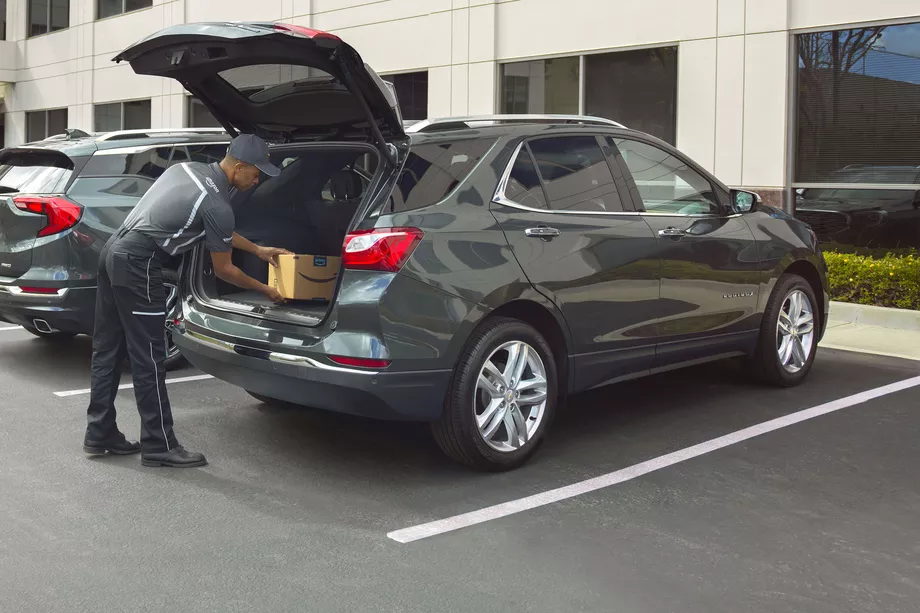
The Amazon Key In-Car service is designed to deliver packages quickly and more securely than traditional services. Instead of driving home to get your package in the middle of the day or hoping that it won’t be stolen from your doorstep or mailbox, you can have your order dropped off in the trunk of your car. Sound good? Well, there’s a catch (or two).
How It Works
First, your car must be parked in a publicly accessible spot so that the driver can reach it. Your trunk will be unlocked using an app on the driver’s phone, so the delivery driver never actually gets a key or access code to your car. (One wonders why it’s called Key In-Car, since no keys are involved, but that’s a question for another day.) Finally, you’ll get a notification on your phone when your package has been delivered.
Safety Concerns
Amazon’s newest innovation is an expansion of their controversial Amazon Key delivery service, which allows delivery drivers to access your home using a specially installed keypad and security camera. Some customers—particularly women—were understandably nervous about allowing strangers into their homes.
You can use the app to block access to your car at any time, for any length of time. As an alternative to in-home deliveries, the Key In-Car service is potentially less intrusive and holds fewer safety concerns.
[adPlaceHolder]Ready to Get on Board?
In order to take advantage of Amazon car-based deliveries, you’ll need to meet several criteria. The pilot program is only available to Prime subscribers in 37 cities in the US.
For now, the service is limited to customers with GM vehicles (Chevrolets, Buicks, GMCs, and Cadillacs) or Volvos produced after 2015. Amazon Key In-Car delivery also requires your vehicle to have an internet-based support function, like OnStar or Volvo On Call, in order to let the drivers remotely unlock your trunk. With these limitations, it’s only for a select few. There’s no word yet on how Amazon may expand the program in the future.
Final Thoughts
Some people will automatically be turned off by this service, especially after reading that security researchers discovered that Amazon’s cloud-connected camera for in-home deliveries can be disabled and frozen from a program run from any computer within Wi-Fi range. While Amazon’s cloud-connected camera provided a layer of security for those who would want to monitor their in-home deliveries through Amazon Key, the in-car deliveries offer no similar video feed. Amazon says that multiple notifications, plus the option to block access at any time, ensures the customer remains in control of the process.
If anything, potential customers may find the in-car deliveries more attractive from a cost perspective. To sign up, you aren’t required to spend $250 on a smart lock and camera like with in-home deliveries, and there’s no installation required. All you need is the right car and the willingness to let Amazon’s delivery employees unlock your vehicle. Frankly, we’re still holding out for drone delivery.