Category: Electronics

  • Two New Joy Con Colors and Better Switch Battery Life

    Two New Joy Con Colors and Better Switch Battery Life

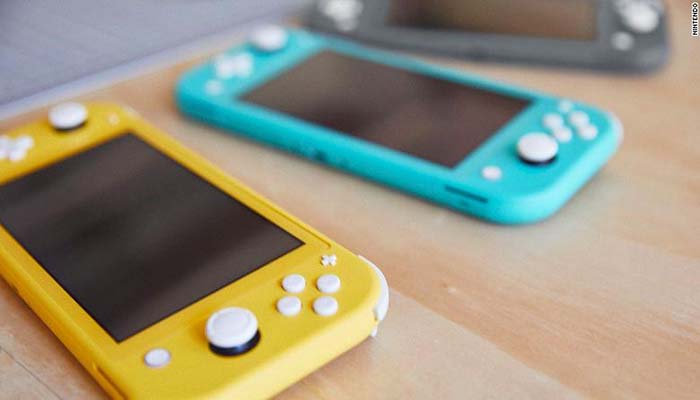
    Only a short week after unveiling the new Switch Lite system, Nintendo has announced two new pieces of news for their incredibly popular hybrid console. The first is that there are two new color combinations for Joy Cons coming soon. The second is that an upcoming hardware refresh for the original Switch will have dramatically better battery life.

    Switch News

    New Joy Cons

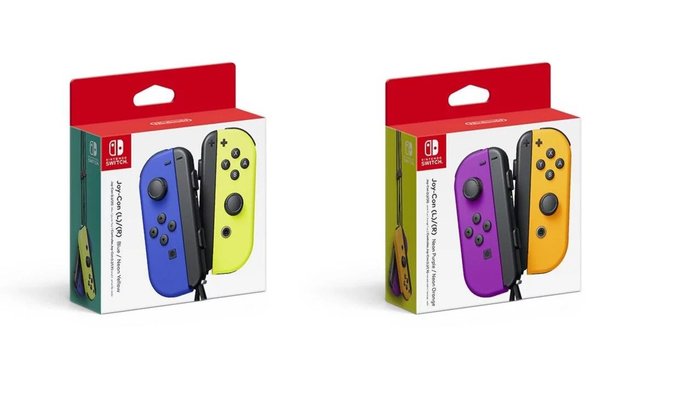
    The new Joy Cons fill in a few more of the two-tone color combinations for Nintendo’s unique Switch controllers. There’s a blue and neon yellow pair, making for a great contrast. Interestingly, the neon yellow Joy Con has been seen once before, though it was bundled with another yellow Joy Con as a promotion for the fighting game game ARMS.

    The second new color pair is the Neon Orange and Neon Purple pair, both brand-new colors for the system. Notably, these are landing on October 4th, meaning they’ll be here in plenty of time for Halloween. This is notable in no small part because Luigi’s Mansion 3, one of the most hotly anticipated Switch titles of the year, is dropping on October 31st to coincide with Halloween!

    Updated Switch Hardware

    While we love our Switches, they have one glaring weak spot: they don’t sport amazing battery life. While the system is great for carrying with you on your work commute, it’s not amazing for long road trips if you forget the charger. Thankfully, Nintendo has a solution to this problem.

    Starting in August, a new batch of original Switch consoles in new packaging will start appearing on store shelves. These have an updated, more efficient chipset that will allow for between two and half to nine extra hours of battery, depending on what you’re using the system for. The new Switch models will be easy to tell apart, as they’ll be sporting a serial code starting with XKW instead of XAW.

    Potential Changes

    The updated chipset in the original Switch comes as no surprise: Nintendo issued a patent for such a design a few months ago. Likewise, this chipset is likely similar to the updated, more efficient Tegra chipset we’ll be seeing in the Switch Lite in September.

    A particular thorn in Nintendo’s side over the two years the Switch has been on the market has been pirates and hackers using a hardware exploit to “jailbreak” their switches. This has allowed some hackers to illegally play duplicated copies of Switch games, a situation Nintendo has cracked down on. It’s likely the updated Switch model will have some methods of preventing this type of hacking.

    Switch Pro Rumors

    Rumors of a completely-updated Switch Pro have been swirling since a few notable publications confirmed that Nintendo had plans for both a lighter, smaller Switch and an updated and beefier version of the console. We know, now, that the rumors for the smaller Switch were accurate, as the Switch Lite fits the description from those earlier leaks. However, the beefed-up “Switch Pro” remains a big mystery.
    It’s theoretically possible that this hardware refresh, with its better battery life and more efficient chipset, could be the rumored “beefier Switch.”

    However, many fans expect to see a more robust update to the base console soon, as the successors to both the Xbox One and PS4 are on the horizon. After all, the Switch’s impressive scaling resolution and adaptive Tegra chip infrastructure allows it to easily scale games up and down for different use cases. It’s not hard to envision a version of the Switch putting out a better resolution while docked and rivaling current-gen hardware.


  • Best Bluetooth Speakers for Your Summer Cookout

    Best Bluetooth Speakers for Your Summer Cookout

    There’s nothing quite like having friends and family over in the backyard while you’re grilling burgers and hot dogs in the back. While you’re at it, why not throw on some great tunes to get the party really going? Today we’re looking at some of the best Bluetooth speakers for your summer cookout.

    We’re going to be looking into speakers based on a few criteria. Firstly, the price point is important, as we don’t want to break the bank. Secondly, sound quality is a big concern, of course. Finally, portability and waterproofing are important for any outdoor-use speaker you buy. Hopefully this helps you narrow it down. Let’s jam!

    Best Bluetooth Speakers

    UE Wonderboom

    It’s no secret that we love UE here at GoodFind: they make all-around incredible Bluetooth speakers. The Wonderboom, which has been around for a while, is now only around $50 at most retailers. For the price, it’s hard to beat the Wonderboom. It’s tiny and light, waterproof and dust-resistant, and it offers great 360-degree sound.

    The bass from this little ball of speaker is impressive, putting out loud and driving sound that doesn’t warp at higher volumes despite its size. If you’re looking for a portable and durable speaker that doesn’t break the bank and will sound great at a pool party, there’s little that beats the Wonderboom.

    Bose SoundLink Revolve

    Bose is well-known for their stellar sound quality, and the SoundLink Revolve is no exception. This great speaker runs for $200, making it a bit pricey, but it’s sure to impress your guests with its powerful sound and deep bass. The SoundLink also offers a wonderful 360-degree sound coverage, meaning it sounds great no matter where you are in the room.

    Notably, this speaker isn’t dust-resistant or waterproof, meaning you’ll need to be more careful with it than some speakers. It’s more of a home speaker, not great for traveling, due to its lack of waterproofing and less robust construction.

    JBL Charge 4

    JBL’s Charge 4 speaker is enormous and heavy, but it offers great bass and can even charge your phone from its huge battery. The Charge 4 might not be the best-sounding speaker, but it’s got a great price point, coming in at $150, and it’s plenty durable. If you’re looking for a modern answer to the classic boom box, this is for you.

    The Charge 4 is waterproof, too, making it a great option for pool parties. Kicking bass sound is great from this speaker, thanks to its large footprint and huge woofers. We wouldn’t recommend this speaker for things like hiking, but it’s great for a pool party where you might need to charge your phone!

    UE Boom 3

    Ultimate Ears is far and away the best Bluetooth speaker manufacturer out there. As such, it’s no surprise that the UE Boom 3 is the best Bluetooth speaker for the money. Whether you’re trying to fill a small space like a dining room with sound, or trying to cover a large back porch area, the Boom 3 has you covered. The sound is huge and rich, the bass kicks well and it just sounds great.

    As with nearly all UE speakers, it’s IP67 waterproof and dust proof, meaning you can toss it in the pool and have a laugh as it keeps kicking out killer sound. The speaker is light, coming in barely over a pound, but it’s still incredibly durable and great for throwing in a bag. You’re not worried about it getting jostled too much, and it’s also not going to weigh down your bag. For only $150, it’s one of the best values out there.


  • Snapdragon 855+: What’s Up With this New Android Chip?

    Snapdragon 855+: What’s Up With this New Android Chip?

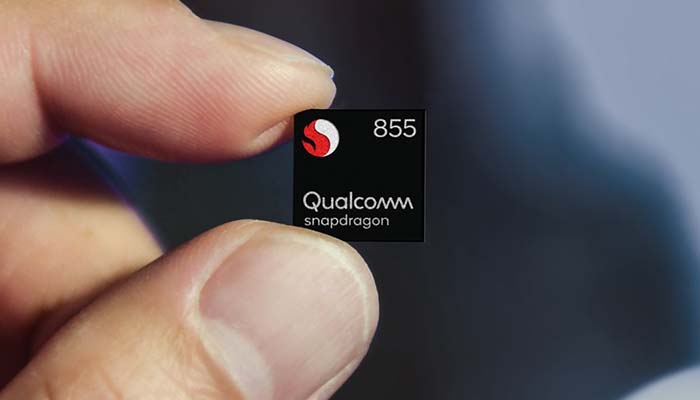
    Qualcomm, one of the biggest manufacturers of Android phone chips, has announced a mid-cycle upgrade for their Snapdragon 855 system on a chip (SoC). The newly-announced Snapdragon 855+ is still an eight-core SoC, and it’s still 7nm, but it has some notable upgrades. What does this mean for upcoming Android phones?

    Today we’re taking a closer look at the hardware that goes into making smartphone tick. We’ll be diving into the technical side of Qualcomm’s SoCs, and what a mid-cycle upgrade could mean for upcoming Android phones. Let’s talk about some silicone.

    System on Chip

    Firstly, a quick primer. A system on a chip means exactly what it sounds like: it’s a computer system on a single chip. While the system in a full-fledged computer, like a desktop or a laptop, has chips specifically for things like processing, graphical capabilities and the like. By contrast, smartphones, tablets and other small technological devices don’t have the space for all of these spread-out components.

    Enter the SoC, and its incredibly useful space-saving capabilities. While you don’t get the same power as you would from a more full-fledged computer, an SoC allows for good performance on a small device without sacrificing much in the way of space or thermal usage. In short, it’s this technology that makes smartphones possible. Were it not for complex and robust SoCs, like Qualcomm’s Snapdragon series, we’d still be using flip phones.

    The Snapdragon 855+

    So, what does this new mid-cycle upgrade mean for Qualcomm? Well, the Prime CPU in the SoC has been bumped up in clock speed. It now clocks in at 2.96GHz, where it was hitting 2.84GHz. This means that the chip can refresh faster, allowing it to accomplish more complex tasks. One of the 855’s strengths is its unusual CPU setup, which sports a “big” cluster of four cores and a smaller set of cores for more power-efficient tasks.

    The 855+ has a new paradigm for this: instead of having a cluster of cores for its “big” core, it now has one Prime core with Cortez A76 infrastructure to handle big tasks. Meanwhile, the new usage of the Prime infrastructure should be useful in delegating tasks, meaning the device will be more powerful overall while also offering better thermals and a lower power consumption for simpler tasks. In short, the 855+ will always use the right tool for the job.

    In Action

    In action, this will mean faster graphics rendering, higher clock rates and better performance. For people interested in using their phones for gaming, levels and textures will load faster. For people more concerned with augmented reality, the graphics will be quicker and more seamlessly integrated. Power users will be able to squeeze tons of utility out of such an upgraded chip, maximizing both their power and battery life.

    Even for users who prefer to use their phones for just browsing the web, answering emails and taking calls, the upgraded chip will offer a ton of new utility and power for any tasks they need to tackle. Swapping between apps, multitasking, screen-in-screen and more will all be faster and more responsive.

    The Phones

    The first phone to roll out with the new chip will be the Asus ROG Phone 2, which will be hitting on July 23rd. We also wouldn’t be surprised to see the new chip infrastructure showing up in the Galaxy Note 10 on August 7th.

    In short, this new Snapdragon 855+ will make for a great upgrade to existing Android phone user interfaces, making gaming and daily use alike faster and more responsive. It’s good to see Qualcomm keeping up with the competition from Apple, who are hard at work on the next iteration of their powerful Bionic chip family.


  • Best 4K TVs Under $300

    Best 4K TVs Under $300

    If you’ve been holding off on buying a 4K TV to wait for prices to drop (and for more 4K content to appear) then you’re not alone. While 4K displays look amazing, they’ve remained rather expensive when compared to 1080p HDTVs. Not to mention, until recently there hasn’t been much support for 4K displays, meaning all that extra power has been largely going unused.

    That’s changed in the last year. With panel prices steadily dropping and the amount of 4K content to stream or play going up, there’s never been a better time to buy into 4K. Today we’re breaking down some of the best deals on 4K TVs you can find, including only screens under $500. We’ve selected these screens based on their relative value when compared to their price. Here’s how to get the most bang for your buck when shopping for a 4K TV.

    TCL 43S517 Roku TV

    Coming in around $250 from most retailers, this TCL 4K Smart TV is a great buy. You get a lot for your money with this one, from built-in Roku support to a bright, clean 43-inch display. While it’s not the biggest 4K TV on the market, 43 inches is a lot for most smaller homes, and would look absolutely massive in an apartment or a bedroom.

    Dolby Vision and Dolby Atmos sounds are both included along with the Smart TV features you’ve come to expect. This means that the sounds and color reproduction are both impressive for a panel at this price range. Once you get this TV, nearly the only thing you’re missing is a soundbar that’s Atmos compatible and you’ll have a serious entertainment setup.

    Element 55-inch Roku TV

    If you’re looking for something with a bit larger panel, then look no further than the Element 55-inch Roku TV. You can usually find this screen for under $300, a stellar price for a 4K panel of this size. Whether you’re looking to put it in your living room or use it as a backup, 55 inches allows for a massive screen that looks great from multiple viewing angles.

    The price might sound too good to be true. A smart TV with a large panel size and a good user interface for less than $400? That’s not very common. However, this Element panel isn’t too good to be true: it’s just a great value. If you’ve never owned a 4K TV and want to ditch your old 1080p screen, then this is a great first step into the world of 4K. You’re in for a treat when you can find this panel on sale, as you’ll get to make a budget entry into the future of display quality.

    Vizio V-Series 50-inch (V505-G9)

    This 50-inch Vizio is another great 4K TV that you can find for under $300 at most retailers. Offering solid HDR support and giving good color reproduction, it’s hard to believe that this panel is as affordable as it is. The user interface is clear and easy-to-read, making this a great first smart TV for a household that hasn’t used one before. The 50 inch size makes it great for a smaller room, though it might look a little out of place in a larger living room.

    Vizio’s built-in SmartCast suite features full support for apps, and it even features support for Chromecast out of the box. This also allows it to connect seamlessly with either Amazon’s Alexa or the Google Assistant, making it a great addition to any smart home network you might be building up. For the low price of $300, this is a seriously cutting-edge screen to add to your modern home. If there were any complaints about it, it might be that 50 inches feels just a tad small for the average living room.


  • Is 5G Going to Make Your 4G Phone Obsolete?

    Is 5G Going to Make Your 4G Phone Obsolete?

    The big shift from one to the next generation of wireless connectivity is right around the corner. This time around, the shift is coming in the form of 4G LTE coverage being augmented by 5G, an event that is being hotly anticipated by tech insiders.

    The question on most consumers’ minds, however, is “will this make my phone obsolete?” In the current smartphone landscape, customers are keeping their phones for longer, upgrading less often and sticking with what they know. This makes the upcoming generational shift a bit uneasy for some people. Let’s take a closer look.

    Availability

    Some big cities are currently seeing major communications companies rolling out 5G networks. They’re all in their infancy at the moment, and they may represent a smaller portion of the current tech landscape than advertising would have you believe. At present, less than ten percent of the country even has access to these networks.

    Beyond this, 5G connections have some notable drawbacks. They’re blisteringly fast: faster, in fact, than fiber optic connection in your own home. However, this doesn’t mean that they’re a strict upgrade over existing wireless communications. Case in point: 5G signals sport a very short wavelength, which means that they can be blocked by trees, double-pane glass and thin walls. They can also only travel a short distance.

    Obsolescence?

    This is where the overlap between 4G LTE and 5G comes in. While the conventional wisdom holds that 5G connectivity is replacing LTE, this is actually inaccurate. As we stated earlier, 5G will be augmenting 4G for years to come. Due to 5G’s inherent limitations, it will need to work with existing 4G infrastructure in order to cross larger distances and work through blocking obstacles.

    What this means is that your 4G phone won’t be going extinct any time soon. In fact, this is likely to mean that your 4G phone is getting a shot in the arm. The addition of 5G technology to existing infrastructures means that you’re likely to see faster, more consistent speeds on your existing 4G handsets.

    How is this Different?

    If this sounds weird, it’s because it is. Prior shifts in wireless technology were massive revolutions, as all of the old tech got tossed out in favor of the new hotness. Wireless communications technology was simply advancing at such an absurd pace that it was hard to even incorporate tech that was a few years old into new infrastructures. That’s changing in the modern era.

    Today, technology is advancing in less dramatic ways. The way data is compressed, the style employed to send that data, is what is shifting now. Existing wireless technology is still great at covering large distances and penetrating barriers. 5G is just a more efficient way of sending that data directly over short distances. In a sense, this will act as an upgrade to existing infrastructure.

    Reasonably Useful

    Another reason why 5G won’t be replacing LTE any time soon is the simple reality of the way people use their phones. Internet speeds and network connectivity are hitting something of an endpoint. Yes, we can make them faster, and yes, there are some uses for 2GBps speeds. However, those uses are incredibly specific and narrow: augmented reality, video game streaming and similarly high-demand tasks.

    Most people just need their phones to stream internet videos and music from their favorite artists. The cost associated with incorporating these ever faster and stronger signals is giving diminishing returns, and most people are quite pleased with their current phone’s performance. There’s just less to improve upon now than ever before. And, in our opinion, this is a good thing. Now, let’s work on just perfecting what we have in front of us.


  • Best Reasons to Get a Nintendo Switch: Gaming on the Go

    Best Reasons to Get a Nintendo Switch: Gaming on the Go

    With the announcement of the upcoming Nintendo Switch Lite and the steady slew of great new games hitting the system, Nintendo’s little hybrid console is red-hot right now. If you’ve been holding off on getting one, this September is your moment. The Switch Lite will be retailing for only $200, making it a very easy entry point for some of Nintendo’s biggest franchises.

    Today we’re taking a look at some of the software that will make you want to preorder your Switch Lite today. From great old standards like Zelda and Mario to returning games from cult favorite developers, there’s a lot of great reasons to own the little system.

    The Legend of Zelda: Breath of the Wild

    Who can deny one of the best video games ever made? Breath of the Wild launched alongside the Switch in 2017, and for a brief period the Switch version of the game actually outsold the Switch itself. While the game also released for the Wii U, its true home has always been the Switch. Exploring Hyrule on the big screen at home or while on your commute to work is where the real magic of the system shines through.

    Mario Kart 8 Deluxe

    Is this a simple port of the Wii U’s best racing game? Well, yes. But it’s beyond amazing: racing your friends around the track has never been more simple, clean and fun than in MK8. The Deluxe version of the game is complete with all of the DLC characters and courses from the Wii U version, and the game benefits tremendously from being playable in both handheld and TV modes.

    Super Mario Odyssey

    Another of the greatest video games ever made graced the Switch in October of 2017: Super Mario Odyssey. Standing alone as one of the last true 3D collect-a-thon platformers, Mario proved why he’s the king of the platforming genre. From capturing enemies to use their powers in interesting ways to duking it out with Bowser on the deck of an airship, Mario Odyssey is a non-stop joyous adventure, made with love and full of wonder.

    Bayonetta 2

    One of the best things about the Switch is that it served as a way for obscure Wii U exclusives to find a wider audience. For a prime example, look no further than the superb Bayonetta 2. Helmed by legendary designers Yusuke Hashimoto and Hideki Kamiya (of Resident Evil and Devil May Cry fame), the game is a showcase of all that is amazing about action video games. Stylish, over-the-top, and just a little ridiculous, Bayonetta 2 is a masterclass in game design.

    Super Mario Maker 2

    What’s better than 2D Mario? Nearly infinite 2D Mario levels. That’s the promise, the premise and the joy of Mario Maker, and the sequel amps this all up by bringing the devilishly simple formula to the Switch. The stage-building game is right at home on the hybrid console: building stages on-the-go with the touchscreen and then playing your friends’ stages while at home connected to the internet is a perfect use of the hybrid console’s unique portability.

    Splatoon 2

    Somewhere between port and proper sequel, Splatoon 2 continues the paintball-splattering fun of the first game. The original was one of the few new IPs introduced during the rocky Wii U era, and the influx of new blood (or ink, in this case) has proven pivotal to Nintendo’s current success. The wild and wacky 4-on-4 action of Splatoon is incredibly fun and addictive, with the three-minute online games flying by in a delightful blur of kinetic action. If you’re looking for a great competitive online shooter with Nintendo’s trademark charm, look no further than Splatoon 2.


  • Best Budget Smart Phones: Getting More Bang for Your Buck

    Best Budget Smart Phones: Getting More Bang for Your Buck

    While everyone knows that Samsung and Google make great phones, they also charge flagship prices for their flagship phones. In order to help you make the most of your money, today we’re looking at some of the best deals out there for smart phone users. Let’s look at the best budget smart phones, starting with the least expensive and working our way up.

    Best Budget Smart Phones

    Moto G7

    Motorola made the first commercial cell phone decades ago, and they’re still producing some of the best budget cell phones you can get. The Moto G7 is no exception to this, either! Despite its low $300 price tag, it’s surprisingly quick and responsive. Many budget phones suffer from laggy, jerky or otherwise weak performance due to their budget processors. Motorola’s done a good job optimizing the Android OS running on this budget phone, however, and it shows.

    The camera is also surprisingly solid for a $300 smartphone. Despite using cheaper parts and sidestepping the expensive multi-camera setups of phones like the iPhone XS and Pixel 3, the Moto G7 takes pretty good-looking photos. The make quality is quite solid, too, sporting a stylish glass back like some of the big flagship phones you see in 2019. All in all, this is a great value for $300.

    Pixel 3A

    The Google Pixel 3A is the budget variation of their stellar Google Pixel 3. While we love the Pixel 3, it’s a little on the pricey side, so the 3A budget version is a welcome addition to the lineup. The most striking thing about the 3A, out of the box, is just how premium it feels for its price. Solid construction, a great-looking display and a strong processor all underscore the otherwise “budget” price of this smartphone.

    The most impressive thing in the Pixel 3A, however, is that there is no compromise on the camera despite the price. Google’s Pixel lineup has been renowned for their stellar camera performance, and the 3A follows in those footsteps. If you’re looking for a great Android phone to snap beautiful pictures and work quickly and easily without breaking the bank, look no further than the Pixel 3A.

    OnePlus 6T

    On the higher end of the “budget” spectrum, we’ve got the OnePlus 6T, coming in at $550. OnePlus might not have a lot of name recognition in America, but it’s a stellar brand that offers up premium-feeling smartphones for less-than-premium prices. The 6T is a generation behind the current OnePlus 7 Pro, but it’s still a rock-solid Android handset with a great processor and better-than-most camera.

    If you’re into flashy technology to show off to your friends, the 6T offers up a cool wrinkle: it’s got an in-display fingerprint scanner, like the Galaxy S10 and OnePlus 7 Pro. The phone also sports monthly security updates, and is sold unlocked on OnePlus’s website. Once you have yours, you need only go by a carrier and get the phone activated.

    iPhone XR

    While few people would call the iPhone XR’s $750 price tag “budget,” it’s got a great suite of features for the price tag. For people interested in dipping their toes into Apple’s new status quo (no home button, Face ID, gesture commands) the XR is the most affordable way to do so. Following in the footsteps of the revolutionary iPhone X, the XR offers up all the power of the flagship iOS device without the flagship price.

    Notable features include the stellar Bokeh-style portrait mode, an overall phenomenal processor, blazing-fast performance and a superb display. Everything about the iPhone XR screams “cutting edge,” from the appearance of the device to its sci-fi feeling Face ID unlock system. If your budget can allow for it, this is a great phone for the tech-savvy.


  • Best Billing and Invoice Software for Small Businesses

    Best Billing and Invoice Software for Small Businesses

    Whether your business has ten employees or a hundred, you need invoicing and billing software. After all, keeping up with who gets money, and how much, is critical to operating your business daily. As such, you need the best billing and invoice software you can get. Today we’re taking a look at some of the best software on the market for your small business so you can get down to business.

    While there’s no one right answer for your business, these are some of the most popular and highly-rated software solutions out there. Your business deserves to succeed, so give it the best chance to by getting the best invoicing software!

    What is Billing and Invoice Software?

    For those who are just starting a small business and might not know, invoicing software is incredibly important to the daily operations of your business. Primarily, this software is for accounting and other financial operations. It can be as simple as something that allows single-entries of data points to more advanced, double-entry applications with more robust features.

    Depending on your business, you might be better served by a simpler software solution that allows you to quickly input and organize data and information. However, your business might be complex enough that it’s more important you have a more thorough and robust software suite available, with functionality such as double-checking your numbers and automating tasks.

    Quickbooks

    One of the most well-known and easily-recognized names in the realm of accounting software, you’ve likely seen commercials from or heard about Quickbooks. That name recognition comes honest: Quickbooks is one of the best software suites for accounting tasks, offering ample features for businesses without overwhelming users with options.

    The user interface is clean, easy-to-navigate and impressive. Task automation is easy and resources to help you find ways to solve problems with Quickbooks are plentiful. One of the best things about choosing a major name like Quickbooks is that most people are already familiar with the software, so your accounting employees will likely have no trouble using it or figuring out how to troubleshoot the software.

    Freshbooks

    Freshbooks, the similarly-named competition to Quickbooks, is another great option for small businesses. While not as recognizable or well-known as Quickbooks, Freshbooks offers a great platform for your accounting needs and is a bit less expensive than Quickbooks. The trade-off, however, is that less people will be familiar with the software, so your accounting employees may need more in-depth training with it.

    Freshbooks is a cloud-based accounting solution, so you can rest assured knowing your books are backed up offsite. Even if your computers go down or somehow you lose your hard drives, you won’t lose all of your accounting information. Automation solutions are as robust as Quickbooks; the only real step down from the competition is that Freshbooks is a bit more complex to learn and use.

    Sage 50cloud

    Another excellent accounting suite you can use for billing and invoicing is Sage 50cloud. Sage’s software solution is, as the name suggests, another cloud-based accounting option. This means that your books will be backed up in the cloud and can be recovered in case you lose your files or hard drive. This keeps incidents like fires or burglaries from being total wipeouts of your data.

    Sage 50cloud is also notable for its user interface. It’s a breeze to set up automated tasks, like payroll or recurring bills and invoices. Organizing invoices and expenditures is easy, and information is presented in a readable and easy-to-parse context. Exporting and importing data is a snap, and you don’t have to worry about minor clerical errors: the software double-checks behind you to make sure everything adds up.


  • Artificial Intelligence: Fact vs Fiction

    Artificial Intelligence: Fact vs Fiction

    One of the most misunderstood terms in computer science is “artificial intelligence”. While many people are familiar with the term artificial intelligence, or its shortened form, AI, they might have a picture of AI in their mind that doesn’t reflect the reality. Sci-fi movies paint a picture of an AI as simply a human-like intelligence that lives in a computer. That’s not entirely accurately.

    Today we’re looking a bit more closely at real artificial intelligence initiatives, how they differ from pop culture depictions of AI, and some of the ethical and philosophical questions raised by artificial intelligence technology.

    What is Artificial Intelligence?

    In simple terms, artificial intelligence refers to intelligence being displayed by machines, in contrast to the natural intelligence displayed by humans and other animals. In the popular conception of an artificial intelligence, the term refers to machines that can mimic natural intelligence features such as problem solving, learning and innovation.

    Within the scientific community, there is an ongoing effect known as the “AI effect.” This observation states that any functionality once thought to be “artificial intelligence” that becomes achievable by current-day machines is no longer dubbed AI. For instance, tasks such as understanding human speech, playing games like chess and Go and decrypting written language were all once reserved for “artificial intelligence,” though they are now common computer programs.

    In short, as Tesler’s Theorem jokes, “AI is whatever hasn’t been done yet.”

    Types of AI

    There are three main types of artificial intelligence. These include analytical, human-inspired and, finally, humanized AI. Analytical AI is the simplest, and encompasses things like learning, problem-solving and understanding representations of the world around them. Human-inspired AI are more complex and would involve the understanding and emulation of human emotion. Essentially, these would be “emotionally intelligent” AI.

    Finally, humanized AI would most closely resemble the sci-fi incarnation of a human-like intelligence that can think, reason, emote and feel in all the same ways as a human being. Humanized AI, in theory, would be fully self-aware, cognizant, and, essential, would have all of the elements that make natural intelligence aware of their place in the world. This form of AI carries serious philosophical and ethical implications.

    Ethics and Philosophy

    Humanized AI raises a serious question: is a sufficiently intelligent computer program, one that shows evidence of self-awareness, a person? Should society extend human rights and legal protections to artificial intelligences? How should we react should the artificial intelligence prove hostile, or hold values contrary to those of its creator?

    Even deeper than these questions, there are serious philosophical questions about the nature of consciousness. We know we are conscious, or, at least, each individual can know that they are conscious. However, it’s difficult to distinguish a sufficiently well-programmed piece of software from a truly self-aware machine intelligence. How can we know that the program in question is actually experiencing consciousness, not just emulating the signifiers of consciousness we programmed into it?

    Reality vs Expectation

    The difference in the reality of artificial intelligence and the expectations of them have led to a number of miscommunications between researchers and their funding. Companies and universities funding AI research often expect fully-aware, sentient AI to leap fully-formed from the researchers’ computers, while the researchers are simply making iterative probes into the nature of machine learning and intelligence.

    In the short-term, it’s unclear if any of the software we currently have could be defined as “artificial intelligence,” due to the AI effect reclassifying innovations as simple machine processes, not intelligence. In the long-term, we will have a number of decisions to make regarding the future of artificial intelligence, how we as a species deal with machine intelligence, and what rights we extend to apparently self-aware programs.


  • Best Employee Time Tracking Software: Smarter Business Solutions

    Best Employee Time Tracking Software: Smarter Business Solutions

    Every business needs the right tools in order to succeed. Chief among these tools are employee management tools. When your employees clock in, when they leave: these are critical data points you have to have great tracking of. Time tracking software is how you generate payroll, and how you accurately keep up with billable hours, time management and project durations.

    When you get employee time tracking software, you need the best. It needs to be reliable, easy to use and easier to read. No one wants to have to decipher crazy tables and illegible data points in order to try to generate payroll. Today we’re looking at a few of the best employee tracking software solutions on the market to help you narrow it down to the best options. Run your business like a pro with these smart time tracking solutions.

    Beebole

    Don’t let the odd name fool you: Beebole is a great app for businesses of any size. Whether you have only 10 employees or 1,000, Beebole can help you to manage your team’s time. Of course, it can track basic time sheets, but it’s also great for coordinating project time management as well as budget monitoring.

    Beebole offers budget tracking, configurable time reports, one-click timers and a lot more. It’s incredibly simple and easy-to-use, but it’s also highly modular and can be configured to do pretty much whatever you need it to. To add to how easy it is to use, it’s also got a mobile app that works on all mobile devices, and can even be used when offline. Beebole only costs $6 per month, and there are even discounts for large groups.

    Scoro

    Scoro is a very popular time sheet program capable of handling tons of functions for your business. The basic time-tracking is there, of course, keeping up with billable hours employee in and out times and project durations. This information is presented in a clear and easy-to-read format, and can be used to help coordinate team efforts on project. This is a stellar tool for people who need their teams to work consistently on time-sensitive projects.

    Scoro is a lot more than just time-tracking, though. It also offers billing automation, quoting and invoicing, time and work reports, CRM and a lot more. It can probably replace three or four different tools you’re already using for these tasks, likely saving you a ton of money. Scoro costs only $26 per month per user, and you can try it out for 14 days for free.

    Harvest

    Harvest is a favorite time-tracking app of hundreds of businesses. It’s one of the best-known time tracking software solutions, and for good reason: it’s a very focused time tracker for businesses of small or medium size. It’s not like the other software suites on this list, though: it’s not a team collaboration tool, it’s primary function is as a time tracker. This single-mindedness makes it incredibly straightforward: it has one job, and it does that job quite well.

    Harvest is available in both free and paid plans. The paid version starts at $12 per month per user. The app supports real-time tracking of time spent on the job, generates estimates of invoices based on collected data, and can even integrate data from across a wide variety of time-tracking tools. In short, there’s a lot of very useful features under the hood of this deceptively simple time-tracking app. Whether you’re running a small business and just need an inexpensive solution for your time-tracking or you’re running a medium-sized business and need an efficient and focused time-tracker, Harvest can fill these roles for you.